


Trekking poles: how to choose and use them
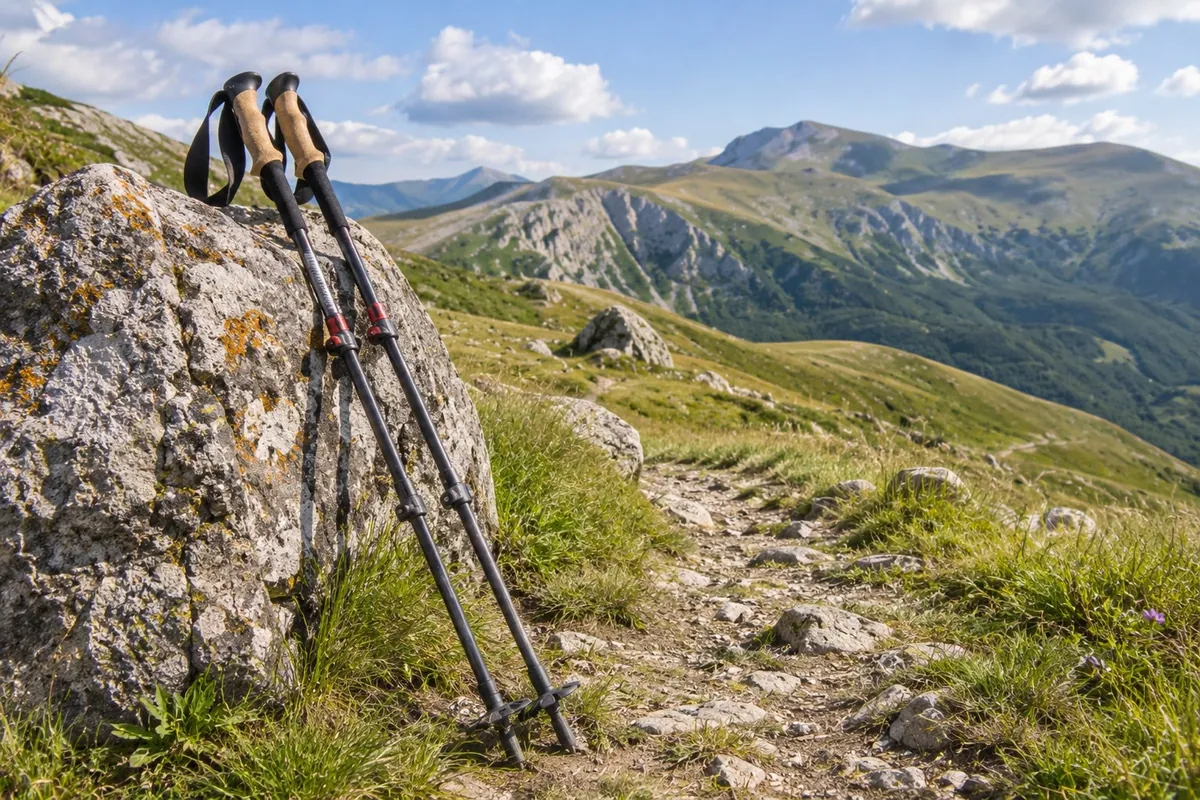
Trekking poles help on uphill and downhill stretches and ease the load on the spine and leg joints, especially the knees. Choosing them well takes only a few criteria: they should be height-adjustable, have a reliable locking system, a material suited to the terrain and a grip that is comfortable in the season they are used.
They are not, however, a tool to hold at all times. The medical commission of the UIAA, the international mountaineering and climbing federation, recommends them mainly for descents and in three situations: older age or excess weight, joint or back problems, and heavy loads on the shoulders. In other cases the pros and cons should be weighed each time.
Trekking poles: how to choose
The first question is not about the model but about the use: on which trails, with what load and in which season. The type of pole, the material and the grip all follow from that.
Who really needs them. Used correctly, poles take weight off the leg joints and make carrying a backpack easier. The benefit is greatest for older or overweight people, for those who already have joint or spine problems and for those carrying very heavy loads. They also improve balance, which matters on snowy slopes, wet ground, stream crossings and in poor visibility.
One or two. Without a load on the shoulders there is no significant difference between walking with one pole or two. With a load, however, balance is clearly better with two.
Adjustable, folding or fixed. Telescopic poles are shortened uphill, lengthened downhill and collapsed to a minimum for stowing in the backpack. Folding models have an elastic core, like tent poles, and fold quickly; very small, ultralight ones, however, are less sturdy and durable. Fixed-length poles are sturdier and transmit fewer vibrations, but cannot be adjusted.
Trekking or Nordic walking. Nordic walking poles are designed for a different motion: they add momentum to the stride, push the body forward and work the upper body as much as the legs. They have a simple strap or an ergonomic glove-style strap with a thumb opening, which lets the hand open between pushes without losing the pole. For regular practice, one-piece models are recommended: rigid and very light but less convenient to carry. Before buying, the intended use, trekking or Nordic walking, should therefore be clear.
Trekking poles: what to look for
Number of sections. Telescopic poles have two or three sections. Two-section poles are sturdier and suited to snow, but heavier and bulkier; three-section poles are lighter and more compact. With three sections it is best to extend the segments evenly, using the marks on the shaft, for the same strength throughout.
Locking system. This is a point to check carefully: an awkward or weak lock can make the pole collapse. An external lever lock is quick and can be operated with gloves, so it suits winter and snowshoeing. The twist lock, where one tube rotates inside the other, is the most common and inexpensive. There are also push-button systems and mixed ones that combine two different mechanisms.
Material. Aluminum is the most common and inexpensive: it resists impacts, lasts a long time and, if it fails, bends without snapping. It is recommended for steep, rough terrain. Carbon fiber is lighter and dampens vibrations better, qualities appreciated on long routes; it costs more, handles impacts poorly and can snap clean through.
Grip. It should support the hand firmly when it pushes down. Cork does not make hands sweat and insulates from the cold: it works in summer and winter. Foam is soft, but it absorbs water and is therefore less suitable in the cold season. Rubber insulates from the cold, but in summer it makes hands sweat and can irritate the skin. Many models have, below the main grip, a foam extension of about 20 centimeters, for holding the pole lower on short steep climbs.
Strap. This is the fabric loop attached to the top of the grip, usually adjustable. The hand goes in from below and then closes on the grip, with the strap running between the pole and the crook of the thumb. This way, at the end of each push, the wrist can rest on the strap and the grip can relax without losing the pole.
Tips and baskets. The tip is metal, usually tungsten, and improves grip on uneven ground, especially downhill; rubber caps protect the tips when not walking. The basket is the plastic disk fitted just above the tip: it keeps the pole from sinking into snow, mud and the small stones of scree slopes. Larger-diameter baskets are for snow; on dry ground they can catch on roots and branches, and it is better to fit smaller ones. They are not always supplied with the poles, and replacements must be compatible with the model.
Shock absorber. Some poles have an internal spring or shock absorber that dampens vibrations and jolts, useful above all downhill and for people with knee and ankle problems. In exchange they add weight and cost, and stability on rocky ground is lower. On some models the shock absorber can be turned off.
Trekking poles: practical tips
Adjust the length before setting out. On flat ground, with the tip on the ground, the upper arm and forearm should form an angle of about 90 degrees, with the forearm parallel to the ground. Uphill the poles are shortened, so as not to raise the arms too high and lose balance backward; downhill they are lengthened, so as not to lean too far forward. On traverses the uphill pole is shortened and the downhill pole lengthened. The wrong length tires the shoulder muscles more.
Keep them close to the body. On flat ground the pole opposite the advancing foot moves forward: right foot and left pole, and vice versa. On steep climbs and descents, plant one pole and then the other, check that they grip and then take the step. In any case they should not be planted far away: if the distance from the body is too great the advantage is lost, and a twisting movement can arise that puts balance at risk.
Stow them when hands are needed. With poles in hand, the hands are not free in case of a fall, and on rocky or protected stretches they get in the way. In the Sibillini Mountains this happens, for example, on the descent from the Sella delle Ciaule toward the Lago di Pilato, where some passages over small rocks require using the hands. In such situations the poles are shortened and strapped to the backpack, preferably with the tips pointing down, so as not to hit people walking nearby in the eyes.
In winter. For the winter hike to Lago di Pilato from Foce di Montemonaco, which in snow and ice is a route for experienced hikers, poles are part of the recommended gear, along with snowshoes or touring skis and, if needed, crampons and an ice axe. In the cold and at high altitude they should not be set too long: while walking, the hands should stay lower than the elbows, otherwise circulation suffers and the fingers soon get cold.
Do not use them on every occasion. Prolonged use can reduce the sense of balance and coordination, a drawback that matters precisely where poles cannot be used, such as on sharp ridges. Downhill, walking technique also counts: small, springy steps, a comfortable speed, no running or jumping, following the bends of the trail without taking shortcuts.
Clean them after the outing. After every hike, especially in rain, damp or snow, it is worth taking the poles apart, removing soil and mud from each piece and letting them dry before reassembling them: they last longer.
For the rest of the equipment, the guides to hiking boots, the hiking backpack and mountain hiking clothing are useful; for snow, those on snowshoes and microspikes for hiking.