


Microspikes for Hiking in the Sibillini Mountains
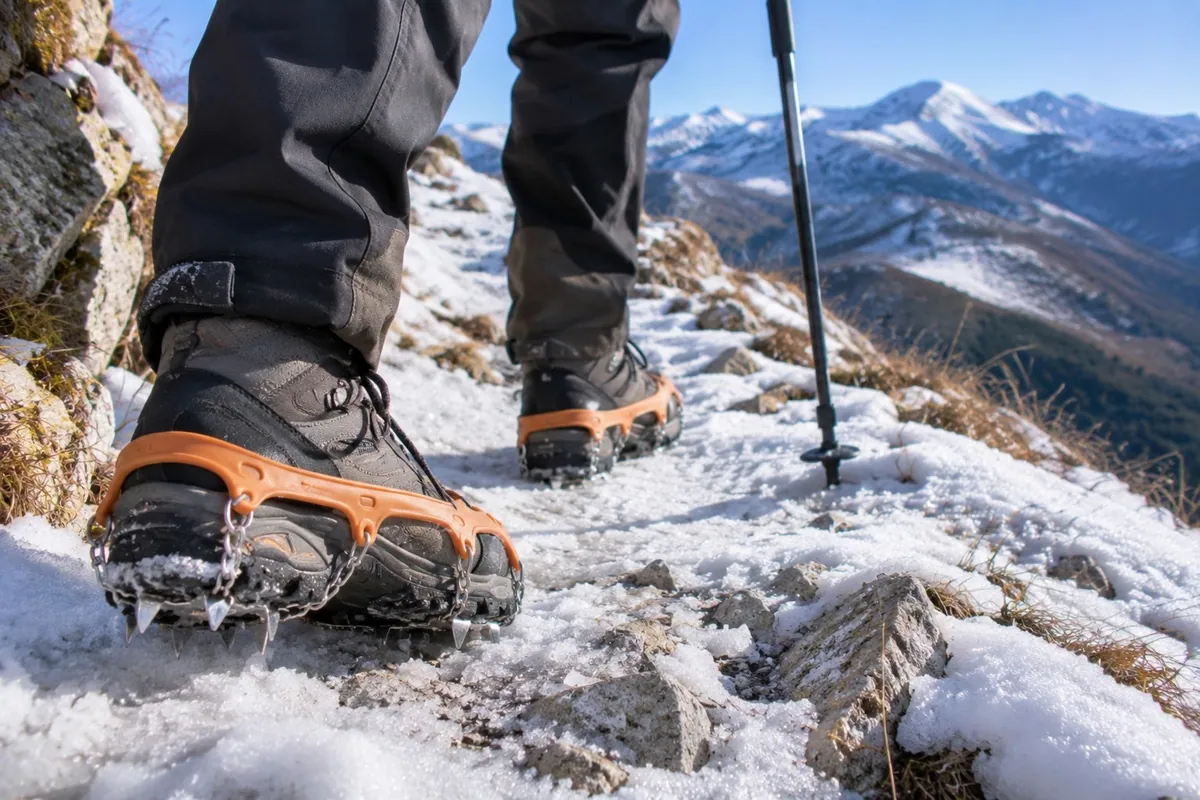
Microspikes for hiking are lightweight traction devices that slip over the shoe for walking on packed snow and icy stretches: they help a great deal on easy, well-trodden trails, but they are not a substitute for crampons. That is the first thing to know before buying them: the mistake to avoid is not about the model but about the use, that is, taking them where mountaineering gear would be needed.
The Soccorso Alpino (Italy's mountain rescue service) is explicit on this point. Microspikes improve grip, but they are suitable only for easy trails with minimal gradients, not for rugged ones; in the mountains and on ice, real crampons, attached to the boot, are needed.
Microspikes for hiking: how to choose
The choice starts from the terrain, not from the product. Three situations can be distinguished, and each one calls for a different tool.
Ice cleats with chains. These are the simplest devices. They work for walking around town, when flat streets and sidewalks are covered by a thin layer of ice or packed snow.
Microspikes. They suit gently sloping trails with packed snow or icy stretches. This includes easy or moderate winter hikes, snow-covered forest roads, icy trails in the woods and gently sloping snowfields in spring. They are also useful as a backup in the pack, when it is unclear what conditions will be found higher up.
Crampons. They are needed when leaving the beaten trails and the terrain becomes steeper, icier or more technical. They have a rigid metal frame with ten to fourteen points, including front points, and require compatible boots.
The line between microspikes and crampons can also be recognized in the field: when it is no longer possible to place the whole sole of the foot on the surface, it is time for crampons. Microspikes have no front points, and for this reason they are not suitable for steep slopes, bare ice, glaciers and mixed terrain.
Once the route is clearly one for microspikes, the choice of model depends on three things: the footwear they will be fitted on, the size and the number of spikes.
Microspikes for hiking: what to consider
Structure. A microspike consists of an elastic harness that wraps around the shoe, chains and metal spikes under the sole. The harness is usually made of thermoplastic rubber, a material that stays elastic even at very low temperatures. The chains are stainless steel and the spikes hardened steel, that is, treated to increase its hardness.
Number and position of the spikes. These vary a lot from one model to another: from a few short spikes to models with more than a dozen spikes spread between forefoot and heel.
Size. Microspikes are sold in sizes that correspond to ranges of shoe sizes. Some models run small, others large, so the manufacturer's size chart should be checked. The right size matters a lot, because microspikes adapt poorly to footwear of a different size.
Compatibility with the shoe. The elastic harness fits almost all hiking footwear, but microspikes work well only on a fairly stiff sole. With a soft sole the shoe deforms under the weight, the microspike squeezes the foot and footing becomes unstable.
Weight and bulk. Lightweight models weigh about 400 grams per pair and fold up easily: they fit in a backpack without any problem. Crampons are heavier and bulkier.
Attachment. They are put on starting from the toe of the boot and pulling the harness back to the heel. Some models have an adjustable strap, which makes the fit more stable: check that it is properly positioned, to keep the microspike from slipping off.
Microspikes for hiking: practical tips
Decide beforehand where you are going. An example from the Sibillini Mountains: in May 2025 anyone wanting to approach Lago di Pilato, at over 1,900 meters, needed crampons and an ice axe and familiarity with alpine terrain: it was not a route for microspikes. Microspikes make sense on beaten, gently sloping trails.
Watch out for hidden ice. Sunny days and little snow can make a trail look safer than it is. In shaded areas, especially near small streams, there can be ice even on short stretches: this is one of the situations where it pays to have a pair of microspikes in the pack.
Do not rely on gear alone. Even crampons, the Soccorso Alpino points out, are very useful but do not eliminate the risks on their own. This applies all the more to microspikes. The route should be assessed carefully before setting out, and if conditions are not safe the right choice may be to turn back.
Complete the winter kit. Those walking on snow can also read the guide to snowshoes and the page on snowshoeing in the Sibillini Mountains. In winter, the kit is completed by hiking boots, trekking poles and suitable mountain hiking clothing.