


Snowshoes: how to choose them
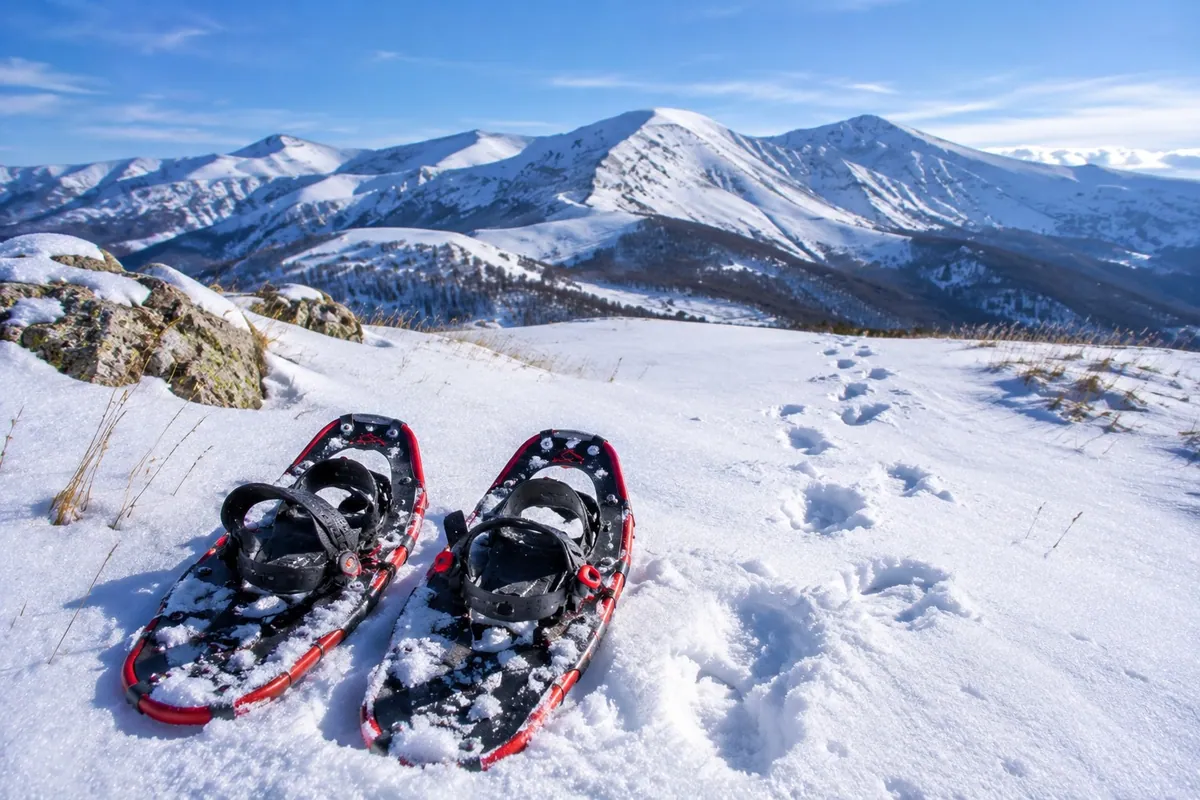
Snowshoes (ciaspole in Italian) are frames that attach to boots and make it possible to walk on the snowpack without sinking in: to choose them well, what matters most is the weight they must carry and the type of snow they will be used on. The name «ciaspola» comes from Trentino. Unlike skiing, walking with snowshoes does not require particular athletic skills, and anyone already used to walking will find no difficulty.
They should, however, be taken for what they are. Snowshoes are mainly for fresh snow; on ice and very hard snow, crampons are needed, which are a different tool. In the Sibillini Mountains guided snowshoe hikes are offered from December to March, when snow and weather allow, for example around Castelluccio di Norcia and Pian Perduto, a high plain, or between Forca Canapine and the Pantani di Accumoli.
Snowshoes: how to choose
The choice starts from weight, not shoe size. Each model has a minimum and maximum load stated by the manufacturer, and the calculation must include the walker's weight together with that of the backpack, boots and clothing: from 5 to 10 extra kilos, depending on the activity. The right snowshoe is the one whose minimum load is very close to the weight of the person dressed and equipped. The higher the load, the larger the snowshoe generally is, and choosing a smaller size is not always a good idea.
As a rough guide: for a total weight between 40 and 70 kilos, snowshoes of about 55 centimeters are enough; between 60 and 90 kilos, snowshoes of 60-65 centimeters are needed; between 80 and 120 kilos, snowshoes of 70 centimeters and up. These are indicative values: what counts is the load range stated for each model.
The second criterion is the snow. Large snowshoes float better on fresh snow and work well on flat stretches, but are less maneuverable. Small ones suit hard, packed snow and steep routes, where agility is needed. On packed, marked routes snowshoes that are not too wide are enough; for fresh snow off the tracks a larger surface is needed.
Two families of snowshoes. Canadian snowshoes are large, shaped somewhat like a tennis racket: they once had wooden frames, today mostly aluminum. They are designed for fresh, dry snow, which is rare at Italian latitudes. Composite snowshoes are the most common in Italy, both in stores and at rental shops in mountain resorts: they have an hourglass shape, are made of very tough plastic materials, are stiffer than Canadian ones and are used by lifting one foot at a time, as in normal walking.
Snowshoes: what to look for
A snowshoe has five parts: frame, flotation deck, cleats (crampons), bindings and, on adult models, a heel lift. Each deserves checking before buying.
Bindings. They keep the foot anchored to the snowshoe and can be fixed or pivoting. The binding is usually hinged, to let the foot flex naturally. The heel can be locked on steep descents and demanding traverses, and left free uphill and on easy ground. The closure uses adjustable straps: slide in the toe of the boot, tighten the front strap, set down the heel, adjust the length to the foot and close the rear straps.
Cleats. These are the spikes under the snowshoe and they determine grip on the snow. On rigid plastic models they are steel, with teeth under the toe and lengthwise rails along the sole, to hold on slopes and on hard snow. It is best to have them at least at the front: they help both uphill and downhill.
Heel lift. This is a support that raises the heel, useful uphill. It reduces the bending of the ankle and calf fatigue.
Frame shape. A frame narrow in the middle allows a natural stride, without having to walk with legs apart. A wide frame gives more stability on untracked snow.
Snowshoes for children. They are lighter, with no heel lift and simple bindings. Some models have plastic cleats.
Footwear. Snowshoes are fitted to warm, waterproof winter hiking boots, high above the ankle so snow does not get in, with a lugged, fairly stiff sole. Snow boots (après-ski boots) are not suitable. Gaiters protect boot and calf from the snow.
Snowshoes: practical tips
Know where snowshoes are not enough. On very hard or icy snow, snowshoes hold poorly. Ideally, carry both snowshoes and crampons, to adapt to the terrain. Those who also walk on icy trails can read the guide to microspikes.
An example from the Sibillini. From the Forca Canapine pass, at 1,541 meters, the snowshoe walk toward the Pantani is easy, while the climb to Monte dei Signori is steeper, and farther on crampons may be needed. On guided outings, the guide chooses the route according to snow conditions.
Check the avalanche bulletin. The Meteomont service publishes a daily bulletin showing the danger for each mountain sector, on a five-level European scale, without going into the detail of individual slopes. Since January 1, 2022, snowshoers too must carry an avalanche transceiver (ARTVA), a shovel and a probe in snowy terrain where snow and weather conditions create an avalanche risk. Beginners do well to stay on marked routes and never set out alone; off the packed tracks, every participant must carry this equipment and know how to use it.
Poles and short steps. Trekking poles are essential for balance, rhythm and stability, uphill and downhill, and on snow they should be used with the larger basket. The typical beginner's mistake is a long stride, which makes you sink more: short steps are better, with the legs slightly wider apart than usual, following an existing track when there is one. The same route takes much more energy than in summer, and trails are harder to follow because the waymarks may be buried.
Dress in layers. Snowshoeing warms you up quickly, so no heavily padded garments. A long-sleeved synthetic technical shirt, not cotton, a breathable fleece and a waterproof, windproof shell are needed; for details see the page on mountain hiking clothing. For the legs, long hiking pants that are unpadded, windproof and water-resistant work well. Synthetic socks, gloves, a beanie, sunglasses and sunscreen complete the kit. The backpack should hold a spare shirt, dry socks, a pocket first aid kit, an emergency blanket and a hot drink.