


The Apennine wolf in the Sibillini Mountains
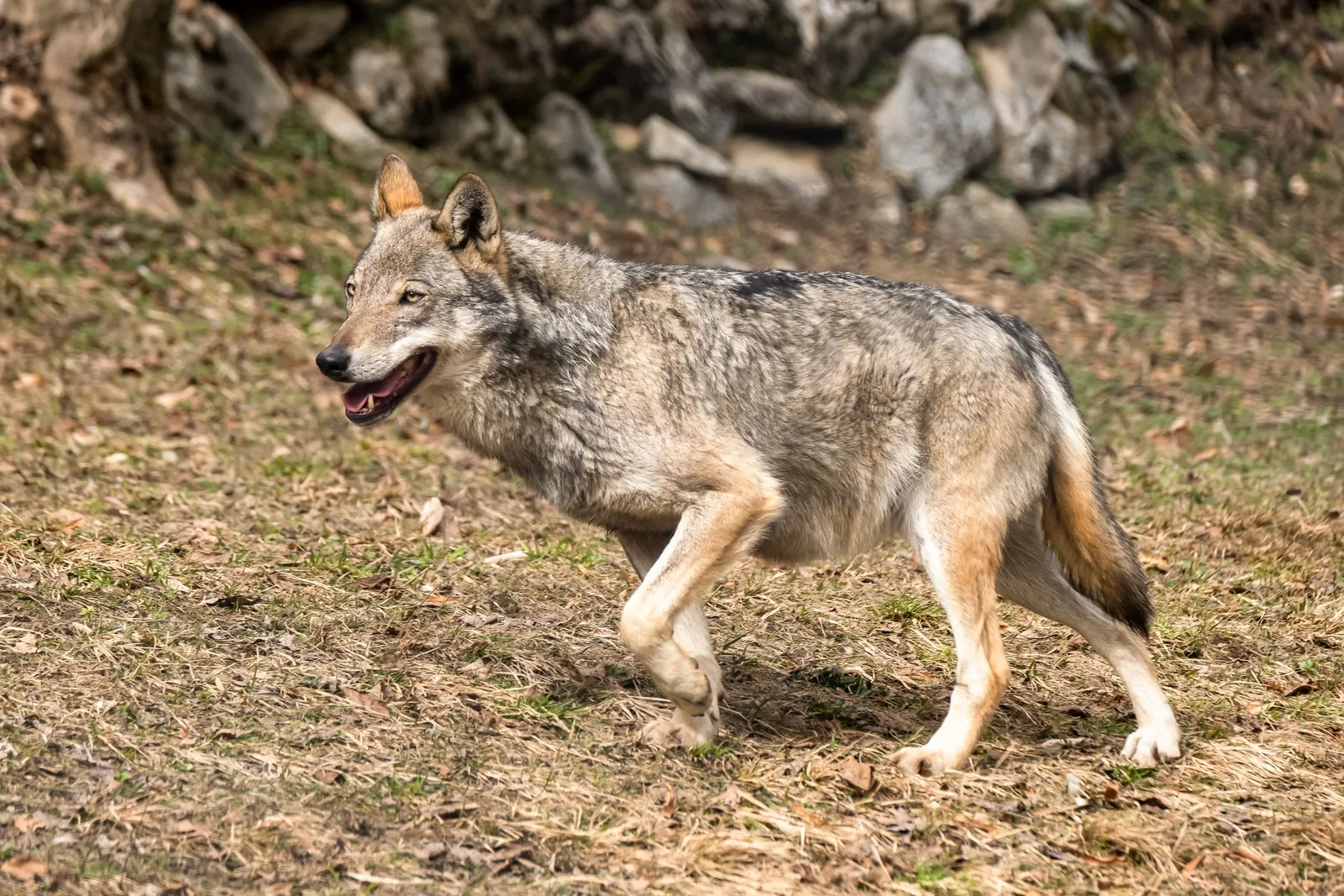
The Apennine wolf (Canis lupus italicus) lives permanently in the national park of the Sibillini Mountains. Data gathered by the Park in 2025 point to 12 breeding units, for about 48 wolves in all. It is an animal that is rarely seen: anyone walking in the Sibillini is more likely to come across its signs than its silhouette.
Its presence here has never completely ceased. For a long time the wolf was considered an enemy of humans and persecuted to the brink of extinction: in the late 1970s very few were left in the Apennines, and some of them lived right here in the Sibillini Mountains. With protection of the species its numbers grew, and today the wolf is permanently present along the whole Apennine chain and has also recolonized the Alps.
How to recognize the Apennine wolf
The Apennine wolf is smaller than Siberian and North American wolves. An adult male weighs about 35 kg, a female about 25 kg; the body measures 100 to 140 cm, excluding the tail, and the shoulder height is 50 to 70 cm.
At first glance it resembles a German shepherd, but a few features help tell it apart. The ears are short, pointed and always erect; the eyes are yellow and slanted. The adult coat is reddish brown with gray shading on the back, while the pups are dark. The gray-tawny base color tends to become more reddish in summer, and dark bands on the back, the tip of the tail and often the front legs are typical. Color alone, however, is not enough for a certain identification: wolf-dog hybrids also exist in the Apennines.
Its habits also help in identifying it. The wolf is a carnivore: an adult eats 1.5 to 3 kg of meat a day, but can go without food for several days. It often hunts large prey such as red deer and roe deer in groups, and also feeds on hares, rodents and birds. In the Park it also preys on wild boar, helping to keep their numbers in check.
It lives in packs whose size depends on the prey available. In the Apennines the pack often coincides with the family unit: a dominant pair, the only one that breeds, and its offspring. Mating takes place between February and March and gestation lasts about two months. First-time mothers usually have two or three pups, older females up to six or seven. A wolf's average lifespan is 8-10 years.
Where the Apennine wolf lives in the Sibillini
The wolf adapts to different environments but prefers mountains with broadleaf woods and thickets, as long as they are intact and little frequented by people.
Counting wolves is difficult, and the figures should be read as estimates. In 2015 the Park reported about 45 wolves, divided into 13 family groups, across the protected area and nearby zones. A study by the Istituto di Ecologia Applicata with the Park's biologists and veterinarians, released in 2022, estimated between 51 and 63 individuals in the Park, counting packs and lone animals. The 2025 data indicate 12 breeding units and about 48 wolves: there is no upward trend, and the population has reached a balance with the territory's capacity to support it.
To monitor the species, the Park combines several methods: camera traps and video traps, collection of fecal samples, induced howling sessions (wolf howling), analysis of predation and satellite radio collars. As part of the Wolfnet 2.0 project, near Visso, Park technicians captured a young male of about a year and a half, fitted him with a satellite radio collar and released him at the same spot.
The main cause of wolf deaths remains humans: 80% of mortality is due to deliberate actions, such as poaching, or accidental ones, such as road collisions.
Coexistence with sheep farming and livestock raising is the most sensitive issue. The Park has funded electric fences to protect flocks, encouraged the use of livestock guardian dogs and provides compensation for lost animals.
When and where to look for the Apennine wolf
A wolf sighting in the Sibillini Mountains cannot be planned. The wolf has a very keen sense of smell and hearing, is wary and usually moves away before a person notices it.
It is more realistic to look for its presence in other ways. Park technicians and the national monitoring program work mainly on signs of presence: droppings collected along set routes, camera-trap images, responses to howling. Induced howling sessions take place at night: a call is made and the team listens, hoping for a reply from the pack and from the pups, which confirms that breeding has taken place. One of these sessions, in 2021, took place on a Park grassland overlooking the gorge toward Fiastra.
Walking quietly and in small groups, as the Park asks, is the minimum condition for any wildlife watching. A pair of binoculars helps in looking from a distance without disturbing. If the animal appears, the Park's rule for any wildlife sighting is simple: stay still and quiet, so the encounter lasts longer.
Rules and responsible behavior
The wolf is a wild animal and must stay that way.
If you meet a wolf. If the wolf is far away, the best thing is to stay quiet and watch without approaching. Never follow or disturb it, especially if it has pups with it or is eating. If it does not move away, walk away calmly, without running.
No food. Feeding a wolf, or leaving food within its reach, gets it used to human presence. For the same reason the Park asks visitors not to leave any litter, not even biodegradable or organic waste such as food scraps: these can alter the habits of wild animals.
Dogs. In the Park, dogs may not enter Zone A, the strict nature reserve, and elsewhere must be kept on a leash. Specific rules apply on the official hiking routes, in force since July 2013 and posted on signs at the trailheads: on 13 routes dogs are allowed on a leash, including stretches in Zone A, and on 4 they are excluded (E8 and E15 entirely, E17 from Capanna Ghezzi to Foce di Montemonaco and E6 from Rifugio del Fargno to Casale Ara del Re). The leash protects wildlife from disturbance and disease transmission, and also protects the dog from possible attacks by sheepdogs and wild animals.
On the trails. Staying on the trails, avoiding shouting and unnecessary noise and moving in small groups are the Park's basic rules, and they apply to anyone looking for the wolf too.
If a wolf approaches. A wolf that approaches people of its own accord is a rare case and should be reported to the Park authority.