


Porta Romana, Ascoli Piceno
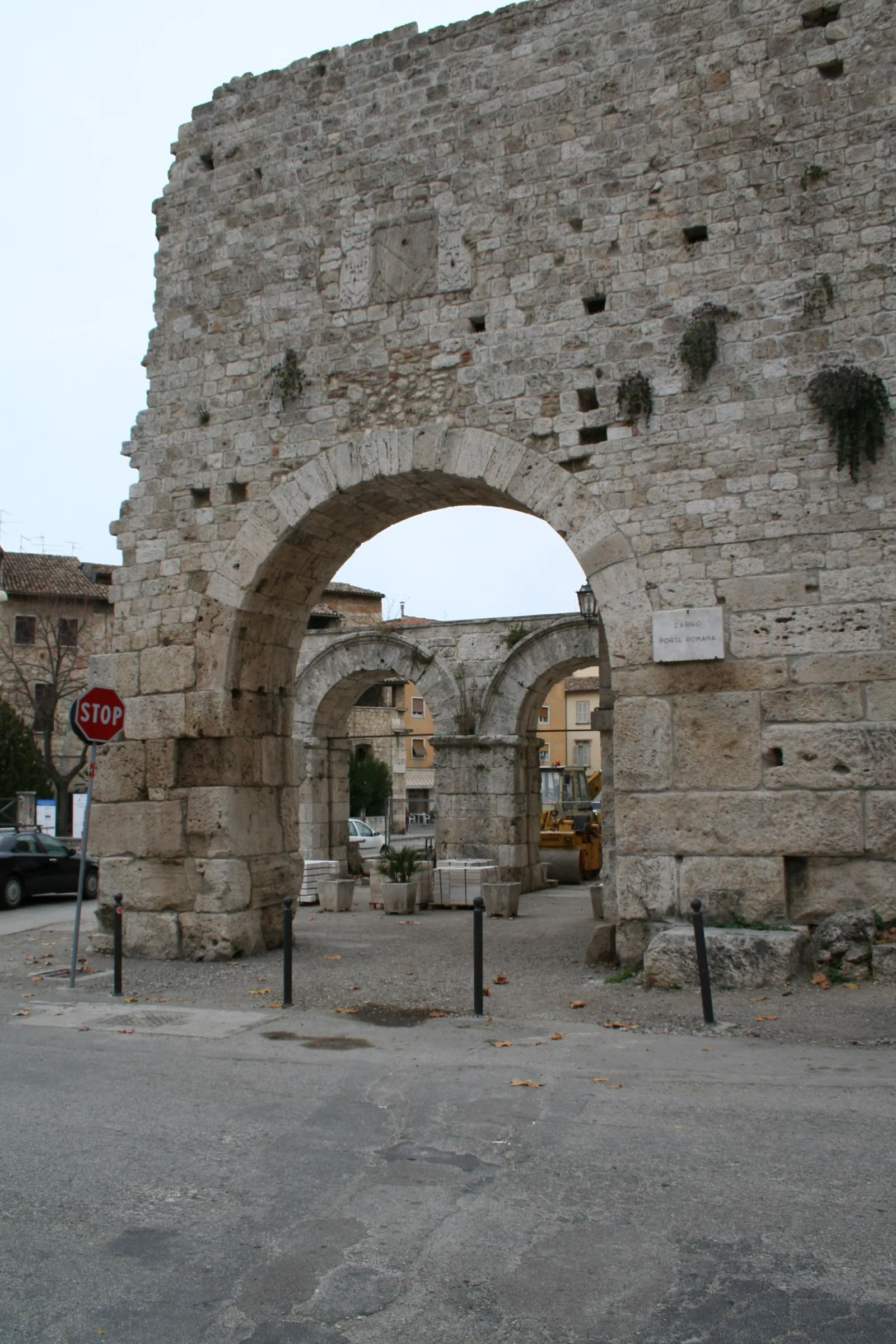
Porta Romana, in Ascoli Piceno, is also known as Porta Gemina and Porta Binata. It is one of the oldest and most important gates of the city. It dates from the 1st century BC and consists of two fornices, that is, two arched passages side by side, resting on three massive pillars of travertine blocks. It is 6.75 m high and 9.47 m wide. Through here, coming from the west, entered those who arrived from Rome along the Via Salaria.
Next to the gate there are still stretches of walls from different periods and a crenellated tower from the 13th century. The monument is also the symbol of the Porta Romana sestiere (district) in the Giostra della Quintana.
Porta Romana, Ascoli Piceno
- Type
- Castle or fortress
- Address
- Piazza Cecco d'AscoliAscoli Piceno (AP)
Source: site database.
On the map
Points from the site database. Map © OpenStreetMap contributors · Protomaps.
History of Porta Romana in Ascoli Piceno
The Roman gate was built on the site of an earlier Picene gate, destroyed by Gnaeus Pompeius Strabo during the Social War. The remains of the Picene gate were found during 20th-century excavations. Through this entrance the Via Salaria, the consular road that joined the Tyrrhenian to the Adriatic, entered the city. The opening lay between the slope of the Colle dell'Annunziata hill, against which the remains of the Roman theater lie, and the Tronto river.
After the damage caused to Ascoli by the imperial army of Frederick II, the gate was restored. On that occasion a second set of medieval arches was added in front of the Roman ones. In the Middle Ages the gate became part of the city's fortification system. Only one arch was used for entering and leaving, because the other could not be used: a small church occupied the space between the Roman and medieval walls.
What to see at Porta Romana in Ascoli Piceno
The two fornices are 5.70 m high and 2.95 m wide. The pillars have a square base, 1.80 m on each side. A cornice connects the arches and also continues over the side pillars. Inside the arches you can still see the grooves that held the portcullises, the sliding barriers that controlled access to the city.
On either side of the gate several phases of the fortifications can be read. There are remains of older walls, in large stone blocks, and remains of Roman walls. A few meters away runs the medieval circuit, built partly with large travertine blocks salvaged from Roman buildings. Next to the gate rises the 13th-century crenellated tower on a circular base.
The outline of the two arches appears, stylized, in the emblem of the Porta Romana sestiere. The sestiere's symbol also includes the mythological figure of the unicorn.
How to visit Porta Romana in Ascoli Piceno
Porta Romana is viewed from outside, walking around the fornices and along the nearby walls. It is in good condition: the structure has been restored. For information on any openings or guided tours, ask at the tourist offices of Ascoli Piceno.
A good starting point is to look closely at the travertine surfaces and the grooves inside the two arches. Then turn to the medieval walls and the tower. These details explain better than any sign how the gate was modified over the centuries.
Where Porta Romana in Ascoli Piceno is
Porta Romana is in the western part of the historic center of Ascoli Piceno, at the foot of the Colle dell'Annunziata, not far from the Tronto river. The district named after the gate is the Porta Romana sestiere.
From the gate the route of the ancient Salaria continues into the city along Via Dino Angelini to Piazza Arringo. This is the most natural way to continue on foot toward the center.
Near Porta Romana in Ascoli Piceno
Very close to the gate is the Roman theater. It was built in the last decades of the 1st century BC and altered in the first half of the 2nd century. Together with the gate, it is among the oldest Roman remains in Ascoli. On the Colle dell'Annunziata there is also the Pia Fortress in Ascoli Piceno.
Other Roman remains in the city include the Ponte di Cecco and the Augustan bridge of Borgo Solestà. Following the Salaria toward the center you reach Piazza Arringo, overlooked by the Duomo, the Baptistery and the Palazzo del Comune. More monuments and itineraries are gathered on the page things to do in Ascoli Piceno.
Frequently asked questions
Why is Porta Romana in Ascoli Piceno also called Porta Gemina?
How tall and wide is Porta Romana?
Which road passed through Porta Romana?
What can you see near Porta Romana?
Nearby
What to see nearby
- under 100 m
- Auditorium San Leonardo, Ascoli PicenoTheater or auditoriumunder 100 m
- 200 m
Where to stay
- Villa Fortezza B&B in Ascoli PicenoB&B or guesthouse300 m
- 400 m
- 400 m
Where to eat
- Macelleria Civilotti, Ascoli PicenoButcher and pork productsunder 100 m
- Copacabana gelato shop in Ascoli PicenoIce cream shop100 m
- Il Posto Giusto, Ascoli PicenoBar and café400 m
Straight-line distances.