


Ercolani Tower (Ascoli Piceno)
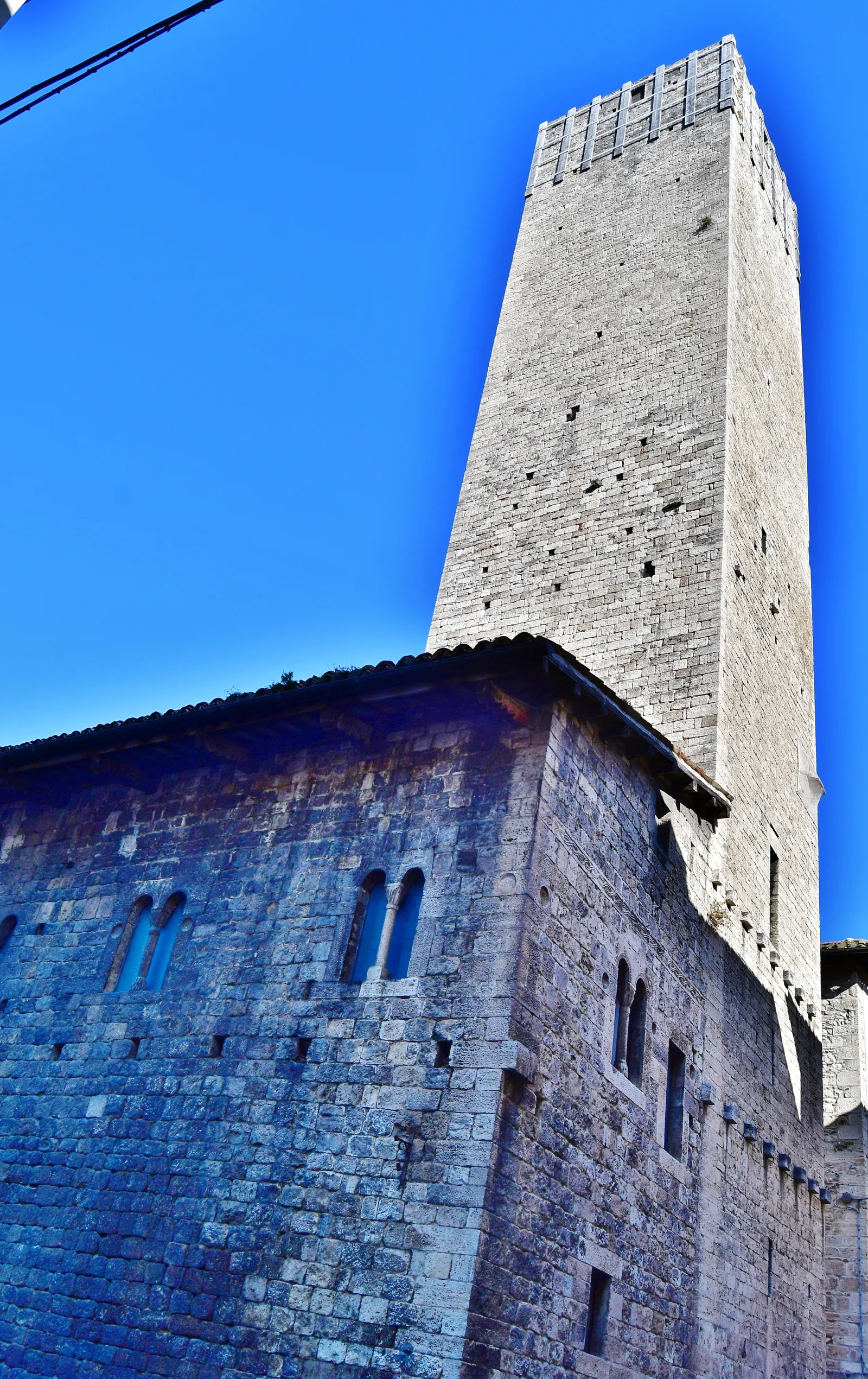
The Ercolani Tower (Torre degli Ercolani), in Ascoli Piceno, is a medieval Romanesque tower in travertine, 34.5 meters tall, with a square base and a profile that narrows toward the top. It stands in the historic center, next to the "Longobardo" (Lombard) palazzetto. Together they form the only example in the city of a palatium-turris (tower house) to have survived intact to this day. It is easy to see from the street, which makes it a simple stop on a walk among the city's towers.
Ascoli is known as the City of a Hundred Towers: in the Middle Ages it had about two hundred, and the historic center still preserves several examples. The Ercolani Tower is among the best preserved.
Ercolani Tower (Ascoli Piceno)
- Type
- Castle or fortress
- Address
- Via dei SoderiniAscoli Piceno (AP)
Source: site database.
On the map
Points from the site database. Map © OpenStreetMap contributors · Protomaps.
History of the Ercolani Tower
The tower dates from the Middle Ages and is Romanesque in style. It was part of an aristocratic residential complex. The noble towers of Ascoli were the visible sign of the power of the families who owned them, but they were also true military buildings.
Tradition holds that in 1242 Frederick II had ninety-one of them torn down. Of that "forest" of towers, about fifty can be recognized today. Some are intact, many have been reduced in height and absorbed into houses, and others have been reused as bell towers.
A construction detail explains the tower's good state of preservation: it is not joined to the palazzetto. This choice allowed the two buildings to stand even in an earthquake, because they are very different in shape and above all in height. The current appearance of the complex is the result of a series of restorations.
What to see at the Ercolani Tower
The first thing to observe is the material. The tower is built of squared travertine blocks. On either side of the entrance, in the lower part of the masonry, there are some courses of large reused blocks from the Roman period. Its dimensions decrease as it rises, a solution adopted to give it greater stability.
The entrance is a small door with a lintel topped by a triangular pediment. This feature also appears on the door of the Baptistery of San Giovanni. On the sides there are windows and openings at different heights, now partly walled up. There are also traces of stone corbels and holes that once held wooden walkways or bretèches, the overhanging structures that strengthened the defense. On the right side an opening that served as an escape route is still visible, reached by wooden scaffolding resting on stone teeth.
Inside, the tower is divided into three floors, each covered by a barrel vault.
The adjacent palazzetto has four mullioned windows on the side of the Rua dei Longobardi and a fifth on via dei Soderini. They mark the floor that was once used as living quarters. The windows were once decorated with ceramic bowls on the sides, and a braided motif runs beneath the roof.
How to visit the Ercolani Tower
The tower is viewed from the outside, from the street. The entrance opens onto via dei Soderini, and that is the best place to stop to take in its full height and the way it tapers toward the top. From here the walkway holes, the walled-up openings and the portal with its triangular pediment are also clearly visible.
For a visit inside, it is best to ask in advance whether access is possible.
Where the Ercolani Tower is
The tower stands in the historic center of Ascoli Piceno, in southern Marche, and faces via dei Soderini. It is next to the palazzetto Longobardo and near Porta Solestà.
The city is 28 km from the Adriatic Sea, at an altitude of 154 m, where the Tronto river meets the Castellano stream. The historic center is built almost entirely of travertine, and its focal point is the Renaissance Piazza del Popolo.
Around the Ercolani Tower in Ascoli Piceno
The nearby palazzetto Longobardo is part of the same complex. A short distance away, toward the Ponte di Solestà, is the Novelli Tower, another medieval noble tower. Anyone following the trail of the noble towers can compare it with the Ercolani tower.
To round off the day, the page on things to do in Ascoli Piceno lists the other sights in the center.
Frequently asked questions
How tall is the Ercolani Tower?
Why is the Ercolani Tower not joined to the palazzetto Longobardo?
How many floors does the Ercolani Tower have inside?
How many medieval towers are left in Ascoli Piceno?
Nearby
What to see nearby
- Novelli Tower (Ascoli Piceno)Castle or fortressunder 100 m
- Noble Family Tower (Ascoli Piceno)Castle or fortressunder 100 m
- Porta Solestà, Ascoli PicenoCity walls and gatesunder 100 m
Where to stay
- under 100 m
- under 100 m
- 100 m
Where to eat
- Laboratorio Alimentare Naturale, Ascoli PicenoDelicatessenunder 100 m
- Il Capriccio degli Dei, Ascoli PicenoRestaurant100 m
- Chisc in Ascoli PicenoRestaurant200 m
Straight-line distances.