


Mistrà Anise Liqueur: What It Is, Recipe and Where to Buy
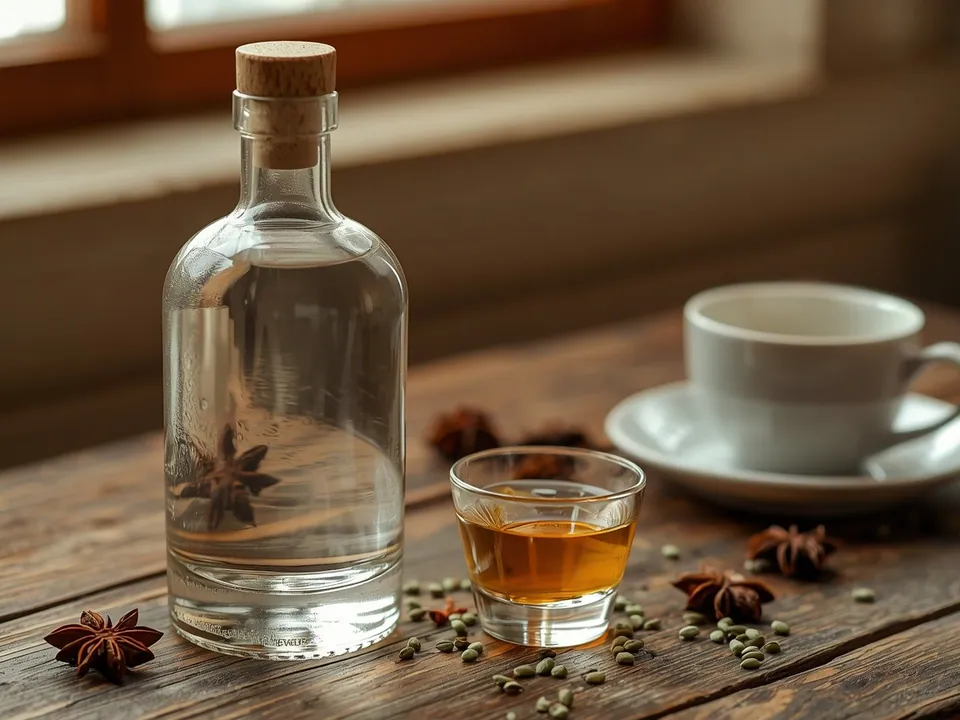
Mistrà is a dry anise liqueur, more precisely a clear, very strong anise spirit. In the Marche it has been drunk after meals for generations: a few drops in coffee, a small glass neat, or diluted with cold water on summer evenings. It is found mainly between the Ascoli and Macerata areas, from the hills of the Piceno and Fermo areas up to the Sibillini Mountains. It is recognized as a traditional agri-food product (PAT) in the Marche, Lazio and Umbria.
The name comes from far away: Mistrà (Mystras) is a fortified town in the Peloponnese, near Sparta, which the Republic of Venice held from 1687 to 1715. In the Sibillini this story passes through Cupi di Visso, where in 1868 the herbalist Girolamo Varnelli founded the family distillery. It also passes through country homes, where many families still make their own mistrà with a recipe that usually stays secret.
Mistrà anise liqueur: origin and characteristics
Mistrà is a dry anise-flavored spirit typical of central Italy. It is obtained from natural distillates of aromatic plants such as green anise and star anise, also called badiana. In Marche peasant tradition it is made from alcohol obtained by distilling wine, to which local anise is added. Today some producers instead make it from pure ethyl alcohol.
Mistrà has a high alcohol content, generally between 40% and 45% by volume. By definition it is a colorless spirit, flavored with anise or natural anethole (between 1 and 2 grams per liter) and with no added sugar. In the glass it is clear, but it turns cloudy when diluted with water or ice. The aroma recalls fennel and licorice.
What sets it apart is its dry taste: anisetta and sambuca, also anise-based, are sweet instead. Differences from one version to another are minimal: wild fennel, green anise or the zest and pulp of other citrus fruits may be added. In homes, the proportions change from family to family.
In the Piceno area mistrà is tied to the green anise of Castignano, in the province of Ascoli Piceno, now a Slow Food Presidium. On the clay, well-drained soils of the calanchi (badlands) of Castignano and Offida, a local variety of anise has been selected over time that is sweeter and more fragrant than others, with an anethole concentration of 94%. Castignano green anise is used for liqueurs, but also for sugared almonds, ring cookies and herbal decoctions. In the Marche anise was already consumed and traded in the 18th century, and in the Piceno area its cultivation was widespread.
The history of mistrà
The history of mistrà begins in Greece. Mistrà was a fortified town in the southern Peloponnese, on the slopes of Mount Taygetus, about 8 km from modern Sparta. It was the capital of the Byzantine Despotate of Morea and has been a UNESCO World Heritage Site since 1989. The Venetians conquered it in 1687 and held it until 1715. There they encountered ouzo, the Greek anise liqueur, brought it home and named it after the town.
For a time mistrà was the liqueur par excellence of the Most Serene Republic. Under Austrian and French rule it lost popularity in the Veneto and, following trade routes, reached the Adriatic coast of the Marche. That is why some people in the area still call it "the sailors' liqueur". Besides the Venetian origin, there is also a popular explanation of the name, which derives it from "mischia" (mix), because the liqueur is mixed with water.
In the Marche mistrà found the right anise and farming know-how to enter every country home, where it was made for family consumption. In the 18th century coppersmiths were the only ones able to build the "tamburlà", the apparatus for distilling wine. In the Piceno area, on the border with Abruzzo and not far from Umbria, home distilling has continued to this day, often at the edge of legality. Some people still produce small quantities with the old copper still inherited from their grandfather.
The link with the Sibillini runs through the Varnelli family. Girolamo Varnelli founded the distillery in 1868: he was an herbalist and lived in Cupi di Visso, in an area that is now part of the Sibillini National Park. He knew the local medicinal herbs and monastic traditions in depth. His first product was an amaro, created as a remedy against malaria and fever. In the early 20th century his son Antonio moved the business to Pievebovigliana. Reworking the Marche mistrà recipe, he created a dry anise spirit that became the house's signature product and in 1950 was awarded in Rome as the best product of its kind.
It is often said that mistrà was created to treat the malaria of shepherds who took their flocks to the Maremma, but this origin has never been documented. The distillery's plant has been in Muccia, in the province of Macerata, since 1996. With the 2016 earthquake, production stopped for about a month.
How to drink mistrà
The most common way to drink mistrà is in caffè corretto (coffee "corrected" with a spirit): its dry taste makes it suited to this use. It is also drunk neat after meals, as a non-bitter digestif, or diluted with water, like Greek ouzo or French pastis; it was already drunk this way in Venice. With cold water it becomes a thirst-quenching drink or an aperitif for summer evenings.
In cooking, mistrà flavors several Marche desserts: castagnole, anise cookies and bostrengo, also called frustingo in some areas. Bostrengo is an old dessert linked to the Christmas holidays. It is made with dried fruit, stale bread soaked in a sort of broth of dried figs, cooked grape must, chocolate, oil and spices. Mistrà is also used in cocktails.
The most common recipe for homemade mistrà involves no distillation: it is an infused liqueur. Anise seeds, wild fennel and coriander are steeped in 90° alcohol in an airtight container, together with orange peel. Indicative quantities are:
- 1 liter of 90° alcohol;
- 50 g of anise seeds;
- 10 g of wild fennel seeds;
- 30 g of coriander seeds;
- 2 orange peels.
After about ten days, prepare a syrup of water and sugar, simmer it over low heat for five minutes and let it cool. Strain the infusion and mix it with the cold syrup. After a couple of days of rest, strain it again.
The result is sweeter than traditional mistrà, which contains no added sugar. For a drier liqueur, reduce the sugar. The orange peel tends to color the liqueur yellow: to keep it clear like the commercial kind, it is better to leave it out.
Where to buy mistrà
In the Marche mistrà can be bought both in large-scale versions and from small artisan producers. Much of what is drunk, however, is still made at home.
In the Sibillini the historic reference is Muccia, in the province of Macerata, home of the plant of the distillery founded in Cupi di Visso. Its products can be bought directly there. The company shop in Pievebovigliana, now in the municipality of Valfornace, closed after the 2016 earthquake.
In the Piceno area there are also artisan spirits that reinterpret the recipe with Castignano green anise and the mela rosa apple of the Sibillini, both Slow Food Presidia, along with about ten other herbs grown locally.
When buying, check the description on the label. True mistrà is dry and colorless, while other anise liqueurs typical of the same area, such as anisetta, are sweet. To round out your shopping with other local flavors, see the page on Sibillini local food products.