


Cessapalombo: what to see and do
At a glance
- Municipality
- Cessapalombo
- Province
- Macerata
- Region
- Le Marche
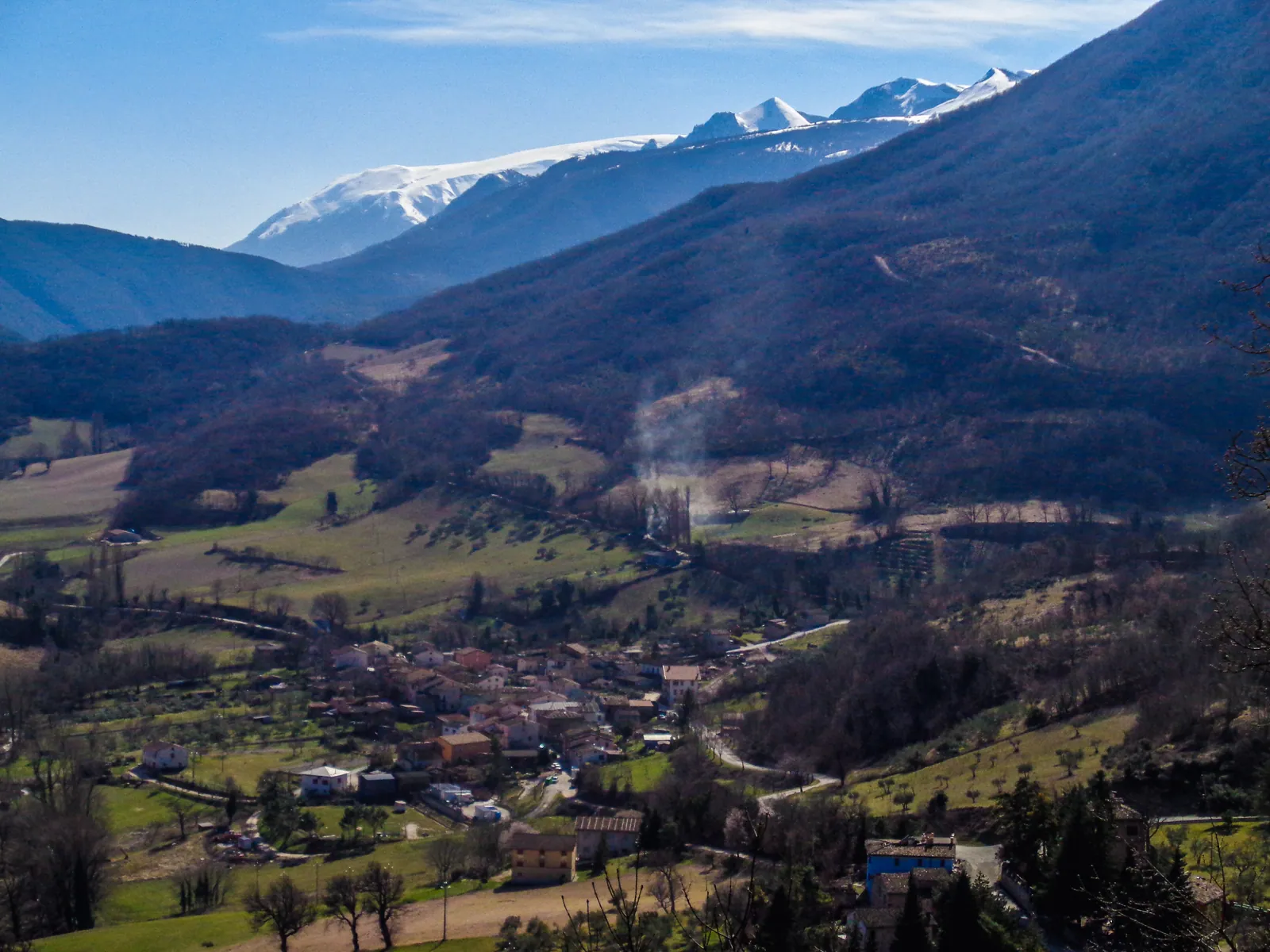
Cessapalombo is a small municipality in the province of Macerata, in the Marche. It lies in the upper valley of the Fiastrone stream and part of its territory falls within the Sibillini National Park in the Sibillini Mountains. The main village sits at just over 400 meters above sea level, but the municipality, of about 28 km², also includes several hamlets scattered among woods and slopes: Montalto, Tribbio, Col di Pietra, Prato, Monastero, Valle di Montalto and Villa di Montalto. The name comes from the Latin caesa, from silva caesa, meaning "cut forest". Here the bond with the woods took the form of the charcoal burner's trade, which for centuries was the main source of income for many families.
The history of Cessapalombo has several layers. There is an abbey that tradition attributes to San Romualdo (Saint Romuald). There are the fortresses that defended the duchy of Camerino and the frescoes of Giovanni Andrea De Magistris. There is also a more recent and painful memory: on March 22, 1944 the hamlet of Montalto saw the execution of 32 young partisans. For its contribution to the partisan struggle the municipality was awarded the War Cross for Military Valor. Earthquakes have struck many times, from 1799 to the 2016 earthquake, whose damage in the main village was still visible in the following years. For the village of Monastero the reconstruction plan was approved in 2022.
On the map
Points from the site database. Map © OpenStreetMap contributors · Protomaps.
What to see in Cessapalombo
The places to see in Cessapalombo are spread between the main village and the hamlets. The visit therefore works well as a tour of nearby localities.
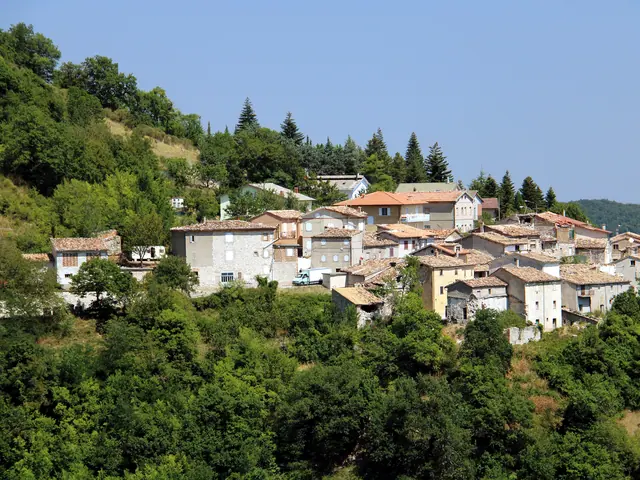
The 1799 earthquake badly damaged the castle of the main village. What remains is the layout of the village and the Church of Sant'Andrea, rebuilt afterward. Inside the church is the 15th-century polychrome wooden statue of the Madonna dell'Impollata.
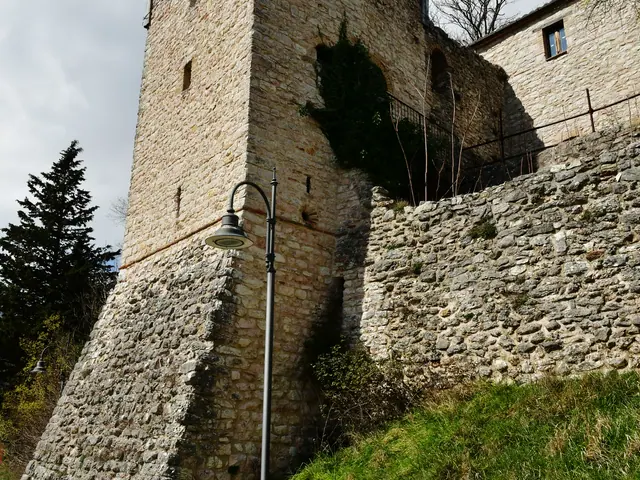
Montalto is the hamlet with the most history. Its territory already appears in a diploma of Otto I dated December 23, 967, and in 1240 it came under the jurisdiction of Camerino. Next to the castle is the 13th-century church of San Benedetto, with frescoes by Giovanni Andrea De Magistris: the Mysteries of the Rosary, dated 1526, and the Madonna and Child and the Saint Anthony Abbot, from 1544. Before the 1944 massacre the partisans had hidden in the community house next to the castle, and that is where they were captured. A small monument recalls the event. Also in Montalto is Il Giardino delle Farfalle (the Butterfly Garden), which includes a multimedia museum, an observation greenhouse and an outdoor park of about 12,000 square meters where butterflies live freely. The visit is guided, lasts about an hour and is recommended in good weather. The Garden had closed after the 2016 earthquake and reopened in April 2018. It is recognized as an Environmental Education Center and as a Park visitor center.
Tribbio lies right below the Montalto Castle and its name comes from trivium, "crossroads". The hamlet is dominated by Palazzo Simonelli, a complex that in the 18th century housed the farming activities of the sharecroppers and was also a summer residence. The restoration kept the original structure and used wood, stone and terracotta. On the ground floor are the Proloco information point and the Casa del Parco (Park house). Between the ground floor and the basement are the Museo delle Carbonaie (Charcoal Kiln Museum) and the Museo della Nostra Terra, with photographs of the charcoal kilns and objects from farm life, and the former church of Santa Lucia, partly frescoed. Since the 2016 earthquake the building has been unusable and the museum closed; in 2025 renovation work was underway.
The Abbazia di San Salvatore, also called Santa Maria in Insula, is in Monastero, outside the village in an isolated spot. A text by San Pier Damiani suggests that San Romualdo founded it in 1009. The original building had three naves and four corner towers: today only the central nave remains. The oldest part is the crypt, with cross vaults supported by nine sandstone columns, capitals among the oldest in the Marche and a 13th-century fresco of the Madonna and Child. The small museum next to the church, which displays finds from the excavations, is closed because of the earthquake. Before going it is worth asking the Comune about access conditions.
At Col di Pietra, above the Fiastrone river, the ruins of the Rocca remain: the watchtower and some vaulted halls can be made out. Lower down, in the village, is the church of San Giovanni, already mentioned in documents from 995. At Villa di Montalto the church of Santa Maria Ausiliatrice holds a 15th-century fresco with the Madonna della Misericordia, Saint Michael the Archangel and Saint Catherine of Alexandria. At Valle di Montalto is the church of San Vito Martire. Each site is described in detail on the page on things to do in Cessapalombo.
Nature and trails near Cessapalombo
Two of the best-known trails in the Fiastrone valley start from Cessapalombo: the one to the Grotta dei Frati and the one to the Lame Rosse. Before setting out there is one important thing to know: the Gole del Fiastrone (Fiastrone gorges) are closed. A 2020 ordinance of the Comune di Fiastra (no. 41), cited by the Park, bans everyone from the gorge trail for safety reasons. With ordinance no. 39 of July 28, 2022, the Municipality of Fiastra then regulated the use of the trails of the Lame Rosse, the Grotta dei Frati and the Gole del Fiastrone: which sections are open is best checked on the Municipality's website.
The Grotta dei Frati is in the territory of Fiastra, but is easily reached from the hamlet of Villa di Montalto. Around the year 1000 the Benedictines settled there. In 1234 a convent and a chapel were built, and the place remained a place of prayer until the 17th century. In 1944 some of the caves served as a refuge for partisans. The trail is easy and takes about an hour and a half each way. It crosses a wood of Mediterranean scrub, hornbeams, oaks and holm oaks, with beeches higher up. From Villa a drivable road climbs behind the church to a pull-out, where the car is left and the trail begins. From the cave a narrow path runs along a very exposed ledge, equipped with a steel cable, leading to the Grotta dei Partigiani. It is a dangerous stretch, with a sheer drop to the valley.
The Lame Rosse are in the municipality of Fiastra, between Monte Fiegni (1,323 m) and Monte Petrella (1,155 m). They are pinnacles and towers of gravel, clay and silt, shaped by erosion. They can also be reached from Cessapalombo. The rules for the trails of the Lame Rosse and the Grotta dei Frati are set by ordinance no. 39 of July 28, 2022 of the Municipality of Fiastra, to be checked before setting out. It is a very fragile environment and must be respected. For fit hikers there is a difficult loop starting from Villa: it climbs Monte Petrella, Monte Fiegni and Monte Cordazzo, descends to Lago di Fiastra and returns via the Lame Rosse and the Grotta dei Frati. It is a long route with a lot of elevation gain.
The Percorso delle Carbonaie (Charcoal Kiln Trail) is a quieter alternative: an educational loop trail through woods, cultivated fields and pastures, along which every stage of charcoal production has been reconstructed. Montalto di Cessapalombo is also the end and start point of two stages of the Cammino Francescano della Marca: the one from Polverina and the one toward Sarnano. The Giardino delle Farfalle also serves as an information point for trails and hikes.
Where to stay in Cessapalombo
In Tribbio the second floor of Palazzo Simonelli has been turned into a hostel. The rooms have private bathrooms and can sleep up to 32 people. There are also two independent annexes for two families, and the hostel kitchen is in the basement. It is best to check availability before setting out.
The full list of accommodation is on the page on where to stay in Cessapalombo.
Where to eat in Cessapalombo
The festivals devoted to woodland products are the best time to discover the food of Cessapalombo. In May the Sagra del fungo (mushroom festival) celebrates this product of the Sibillini Mountains. On the first two Sundays of October the hamlet of Villa di Montalto hosts "Antichi Sapori e Ricchezze del Bosco" (Ancient Flavors and Riches of the Woods), a festival devoted to rural life, local products and old trades. The dates of each edition should be checked year by year.
Local products of Cessapalombo
The product most tied to the identity of Cessapalombo is not edible: it is wood charcoal. Cessapalombo is one of the few municipalities where this tradition is still alive. Charcoal is made by "cooking" wood without air inside the charcoal kiln, called 'ncotta, a stack shaped like a truncated cone between 1.5 and 2 meters high. It was once produced directly in the mountains and carried by donkey to the markets of nearby towns. It takes 7 to 10 days of work, and today very few charcoal burners remain. The Park's charcoal, made with the traditional method, used to be sold at the Museo delle Carbonaie, closed after the 2016 earthquake.
The woods also provide mushrooms, truffles and chestnuts. The farms produce chickpeas, lentils, spelt and other cereals and legumes, extra virgin olive oil from the Coroncina variety and beef from the Marchigiana breed. Almost all of them also grow saffron, thanks to a project of the University of Camerino that gave rise to the producers' association Tipicità dei Sibillini. The association is based at the Giardino delle Farfalle, where there is also a shop selling local food and crafts.
Weather and how to get to Cessapalombo
By car, Cessapalombo is reached from the SS 77 of the Val di Chienti: exit at Caldarola, go through the town and continue on the SP 502 following the signs. From the A14 highway exit at Civitanova Marche and take the SS 77 toward Tolentino. From Rome take the Flaminia (SS 3) until joining the SS 77. To reach Monastero and the abbey, take the SP 91, which links Pian di Pieca to Fiastra.
The nearest train station is Tolentino, on the Civitanova Marche–Fabriano line. From Tolentino, Contram Mobilità buses connect the neighboring towns. The reference airports are Ancona-Falconara and Perugia.
The recommended period for the trails of the Fiastrone valley runs from April to November, when there is no snow. The trail to the Grotta dei Frati is mostly shaded and can be walked comfortably even on the hottest summer days. In any season it is worth checking the weather before setting out.
In this section
2 results
No results with these filters.