


The chirocefalo del Marchesoni, the tiny crustacean of Lago di Pilato
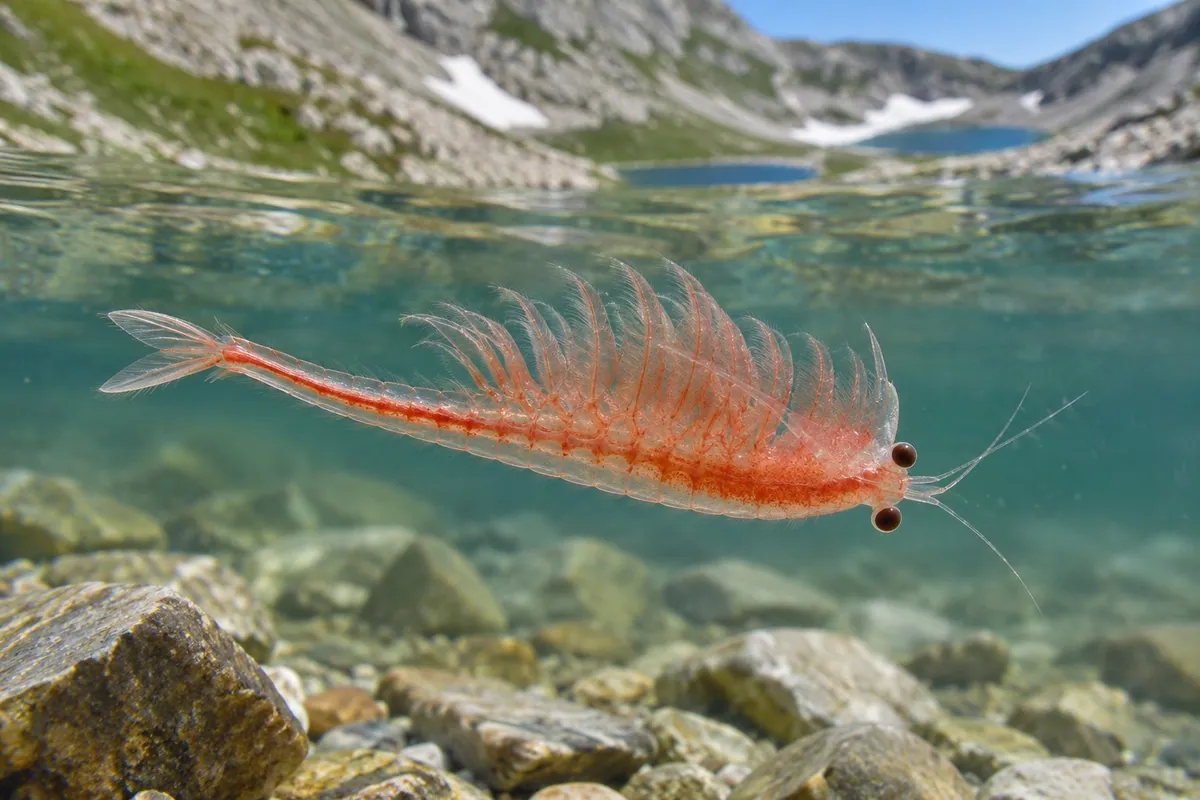
The chirocefalo del Marchesoni (Chirocephalus marchesonii) is a small coral-red crustacean, a fairy shrimp about one centimeter long, that lives in only one place in the world: Lago di Pilato, at 1,941 meters on the slopes of Monte Vettore, in the national park of the Sibillini Mountains. Its entire existence depends on this glacial lake, fed only by snowmelt and precipitation.
This is why the rules for visiting the lake are strict. The eggs of the fairy shrimp stay among the stones of the shores and the lake bed even when the water disappears, and simply stepping on them destroys them.
How to recognize the chirocefalo del Marchesoni
The chirocefalo del Marchesoni is an anostracan crustacean, meaning it has no shell. It has an elongated, almost cylindrical body divided into head, thorax and abdomen; the thorax bears eleven pairs of appendages, used both for swimming and for breathing. Males and females measure between 9 and 12 millimeters.
Two features make it unmistakable. The first is its color, a coral red. The second is the way it swims: it moves belly up, beating its appendages.
The eggs are spherical, with an average diameter of 0.43 millimeters. A larva hatches from the egg and gradually takes on its adult form through successive molts.
The species was first observed in 1954 by Vittorio Marchesoni, director of the Institute of Botany at the University of Camerino, during a hike. In 1957 Ruffo and Vesentini, studying new samples, recognized it as a new species and named it after its discoverer.
Where it lives in the Sibillini Mountains
The chirocefalo del Marchesoni lives exclusively in the basin of Lago di Pilato: no other place hosts a population. It is a stenothermal species, adapted to cold environments, and this ties it to the cold waters of a high-altitude lake.
Lago di Pilato has no inflowing streams. It forms every year as the snow melts, usually between May and June, and its level varies greatly depending on the winter snowfall. In some years the water fills the whole hollow and the two basins join in the characteristic “glasses” shape; in others the two pools stay separate, and in dry periods the lake dries up completely.
In the past the lake had dried up completely only rarely, for example in 1990 and 2002; since 2017, however, the summer dry-out has become almost the rule, with the exception of 2018, and in summer 2024 the basin was again completely dry. Monitoring by the Park with the University of Perugia, begun in 2018, shows that the lake is becoming more and more temporary, especially after 2016. In June 2026, after a snowy winter, the lake once again showed its glasses shape, which had not been seen for about ten years.
The fairy shrimp survives these swings thanks to its eggs. The adult, swimming form lives only a few months. The eggs, instead, are resistant cysts: laid on the bed and in the gravel of the shores, they stay viable in dry conditions even for several years, provided the sediment is not disturbed, and hatch when conditions become favorable again. It is a strategy suited to an extreme and unstable environment, but it has a limit: if dry spells repeat for several years in a row, the survival of the species is at risk. Climate change and hydrogeological changes, including those linked to earthquakes, could make dry spells more frequent and longer.
A second, lesser-known endemic fairy shrimp also lives in the Park: the chirocefalo della Sibilla, found in the laghetto della Sibilla, a small pond.
When and where to observe the chirocefalo del Marchesoni
The chirocefalo del Marchesoni can be looked for only at Lago di Pilato, and only when there is water in the lake. Its life cycle follows that of the lake: in normal conditions the adults are present between early June and the end of September.
The calendar, however, matters less than the state of the basin. The lake begins to form with the thaw, and in a year with little snow it may already be dry in midsummer: in 2024 it was dry by the end of July. Before heading up, check the condition of the lake with the Park.
It also pays to have realistic expectations. The fairy shrimp is about one centimeter long, and the rules require the lake to be viewed from a distance from the shore. Binoculars help in watching the water without getting closer.
One of the approaches starts from Foce di Montemonaco. The lake is at high altitude: early in the season the trail may still be snow-covered, and in May 2025 crampons, an ice axe and experience of alpine terrain were needed to get near it. In the lake basin, which is Zone A of the Park, dogs are not allowed, not even on a leash. In 2013 the Park also excluded them from some official hiking routes, including E17 from Capanna Ghezzi to Foce di Montemonaco and E15 (Forca di Presta, Vettore, Colle di Montegallo): the rules for each route are posted on signs at the trailhead.
Rules and responsible behavior
Lago di Pilato lies in Zone A, the strict nature reserve of the Park. The rules exist to protect the eggs of the fairy shrimp, which are invisible among the stones and very vulnerable to trampling.
- Stay away from the water. Do not approach the shores beyond the lake's high-water line, marked on site by a barrier, even when the basin is low or dry: the eggs lie right there, in the gravel.
- Do not touch the water. The Park asks visitors not to touch it, so as not to alter its chemical and physical characteristics.
- Dogs and other animals. Pets must not be taken to drink from the lake. In the lake basin, which is Zone A, dogs are not allowed, not even on a leash.
- Scree and trails. Do not descend the scree slopes, which are fragile ecosystems, and do not leave the marked trails.
- No tents. Wild camping and bivouacking are forbidden. In the lake area, the Park's conservation measures make an exception only for the bivouac cave below the Gran Gendarme.
- Litter. Carry everything back down, including organic scraps.
When the lake is dry, the Park may fence off the entire perimeter of the basin, as it did in 2024, to stop hikers from walking on the bed. The barrier must not be crossed.