


Sibillini Mountains guided hikes and hiking guides
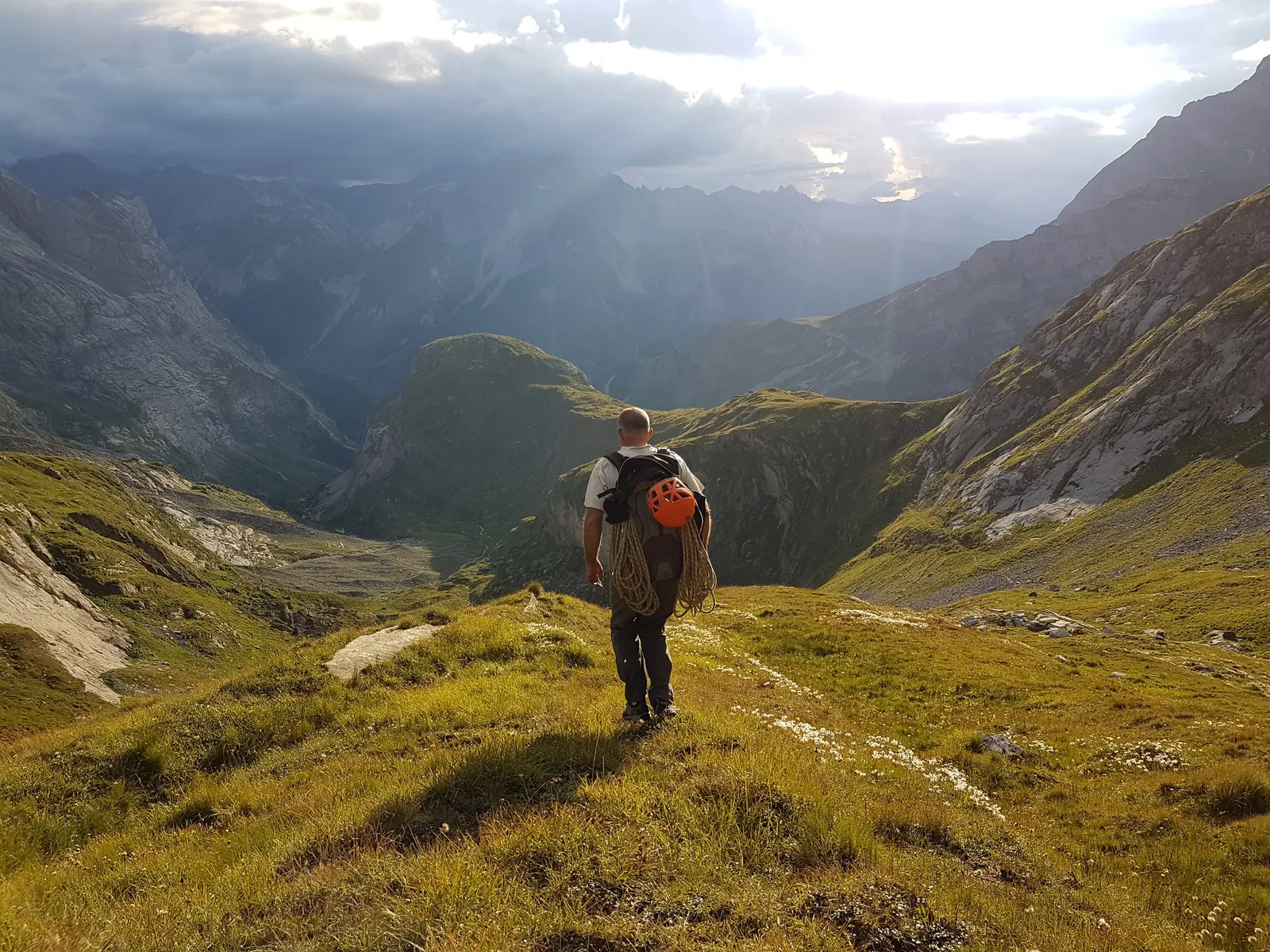
A Sibillini Mountains guided hike is led by qualified guides who take groups, couples and families along the trails of the National Park, between the Marche and Umbria. Routes range from walks of about three hours to demanding climbs to the summits of the Sibillini Mountains. Two kinds of guide work in the area: the Park's official guides, listed in a register and trained through specific courses, and environmental hiking guides licensed by the region. The Park itself recommends relying on them for the most delicate destinations, such as Lago di Pilato.
The offer includes day trips, sunset hikes, evening outings under the stars and multi-day treks, up to the Grande Anello dei Sibillini, the long loop trail around the range. This page explains how to choose, which season to go in and what to know before setting out. For other activities in the area there is the page on things to do in the Sibillini Mountains.
Sibillini National Park guided hikes: what to know
The official guides of the Sibillini National Park are listed in the Park's register and have completed the training courses required by the framework law on protected areas (Law 394/1991). Their task is environmental interpretation, that is, helping people read the landscape, wildlife, geology and history of the places. The register is updated, and the list of guides can be consulted on the Park's website. Alongside them work environmental hiking guides licensed by the Marche Region, who organize outings for groups, couples and families in the Park and nearby areas. There are also other professional figures, each with its own specialty: mountain guide, nature guide, hill and mountain walking leader, horseback riding guide, ski instructor and mountain bike instructor.
Sibillini National Park tours fall into a few categories:
- Day trips to peaks and valleys, with the difficulty and physical effort stated for each program.
- Sunset hikes, sometimes returning in the evening.
- Multi-day treks, including three-day ones, with logistics and overnight stays organized.
- Themed outings: spotting roe deer and red deer (so-called wild-trekking), wildflower blooms, walks between hermitages and villages.
Some hikes include carpooling to reach the starting point.
To give an idea of durations, the fall 2026 calendar of guided outings offers some examples:
- Lame Rosse (Fiastra): about 3 hours, 8 km, 300 m of elevation gain, easy-to-moderate difficulty.
- Gole dell'Infernaccio and the hermitage of San Leonardo (Montefortino): about 3 and a half hours, 7 km, 300 m of elevation gain.
- Sentiero delle Acque (Pieve Torina): about 3 hours, 10 km, 300 m of elevation gain.
- Monte Sibilla, ridge and cave (Montemonaco): about 5 hours, 12 km, 710 m of elevation gain, for experienced hikers.
- Loop of the three summits of Monte Bove (Ussita): about 6 hours, 15 km, 1,000 m of elevation gain, for experienced hikers. The loop climbs from Frontignano: until December 31, 2026 the route is closed even on foot under Ordinance no. 48 of August 25, 2026 of the Municipality of Ussita.
Calendars change every season, so these figures serve only to give an idea of the effort required.
Those looking for gentler routes will also find easy ones, such as the Rio Sacro valley, in the north of the Park. It is a comfortable dirt road that follows the stream, in a valley where wolves and golden eagles live. Winter outings are offered too: at the Piani di Ragnolo there is an easy snowshoe hike (for snowshoes see also snowshoeing in the Sibillini Mountains and snowshoe rental).
Lago di Pilato deserves a separate mention. It lies at 1,941 m, in the municipality of Montemonaco, and is the most fragile ecosystem in the Park. The Park has recognized as historic trails the three that start from Foce di Montemonaco (It 132, It 152, It 151). Other tracks, such as those from Castelluccio or from Forca di Presta, a mountain pass, are not waymarked and can be dangerous, even though the Park does not prohibit using them. The route from Foce is demanding: about 1,000 m of elevation gain and an average of 2 and a half to 3 hours of walking on the way up. For this reason the Park suggests going up with the Park guides or with qualified associations such as the Club Alpino Italiano.
The Grande Anello dei Sibillini is the Park's official trek. It starts from Visso and circles the entire range in nine stages, for a total of about 124 km. The stages are waymarked (red-and-white signs) and take from about 3 to 6 hours of walking: Fiastra–Monastero, for example, takes about 3 hours, while Monastero–Garulla takes about 5 hours and 50 minutes. Those who prefer not to tackle it alone can join guided trips with a leader. Along the route, many villages still bear the marks of the 2016 earthquake.
Monti Sibillini guided hikes: when to go
The best season runs from April to October, with different peaks depending on the route. For the Grande Anello the recommended periods run from mid-May to October. Until late spring, however, Lago di Pilato may still be surrounded by tongues of lingering snow, for example on the climb from Foce di Montemonaco.
- Spring blooms. The Piani di Ragnolo bloom between May and June and are a classic destination for seasonal hikes.
- Castelluccio in bloom. The Castelluccio plateaus are in flower from late May to mid-July, with the peak bloom usually in the last week of June. The flowering lentils color the plain red, purple, yellow and blue.
- Summer. July and August are the recommended months for climbing to Lago di Pilato, while September is quieter and less crowded.
- Fall. In September and October the landscape takes on the colors of fall foliage. For walking away from the summer heat and crowds, late September is considered one of the best periods.
- Winter. Snow opens up snowshoeing. For skiing and snowshoes see the dedicated pages: the things to do in the Sibillini Mountains page collects them all.
Monti Sibillini tours and guided hikes: practical tips
Choosing the right level. Outings state the difficulty (easy walking, hiking, for experienced hikers) along with duration, length and elevation gain. It is worth comparing these figures with your own fitness. The Park warns that the summits and the highest routes often require experience, training and suitable gear.
Gear. Climbing to Lago di Pilato requires hiking boots and trekking poles. Layered clothing and good physical condition are also useful, because the weather can change quickly at altitude. The trail leaves the woods along stretches exposed to the sun.
Trail conditions. After the 2016 earthquake some routes were damaged. The trail that climbs to Lago di Pilato from Castelluccio via Forca Viola has been affected by landslides. Some Sentieri Natura (nature trails) may be closed or only partly passable. Before setting out it is worth asking the guide and the Park authority which routes are open and whether there are ordinances or restrictions, particularly for Lago di Pilato.
Rules at Lago di Pilato. The lake lies in a strict nature reserve. It is prohibited to:
- leave the marked trail and walk on the scree slopes;
- go closer to the shores than the maximum water level limit, marked by signs or small fences;
- swim or dip your feet, and bring dogs or other animals, even on a leash;
- collect animals, plants, rocks and fossils;
- light fires and camp;
- use drones, mountain bikes and motor vehicles on the trails leading to the lake.
When the lake dries up it is also prohibited to walk on the lake bed, so as not to disturb the eggs of the chirocefalo (Chirocephalus), a small crustacean that lives only here. Observation is done from the side below Cima del Redentore.
Accommodation. In August places to stay fill up and finding one at the last minute is difficult, especially around Montemonaco, where not all of them have reopened since the earthquake. It is best to book well ahead.
Other ways to explore. Those who prefer a different pace can look at tours on horseback (horseback riding and trekking in the Sibillini Mountains) or by bike (mountain biking and e-biking in the Sibillini Mountains). There are guides who specialize in these activities.