


Valnerina: villages, nature and things to see
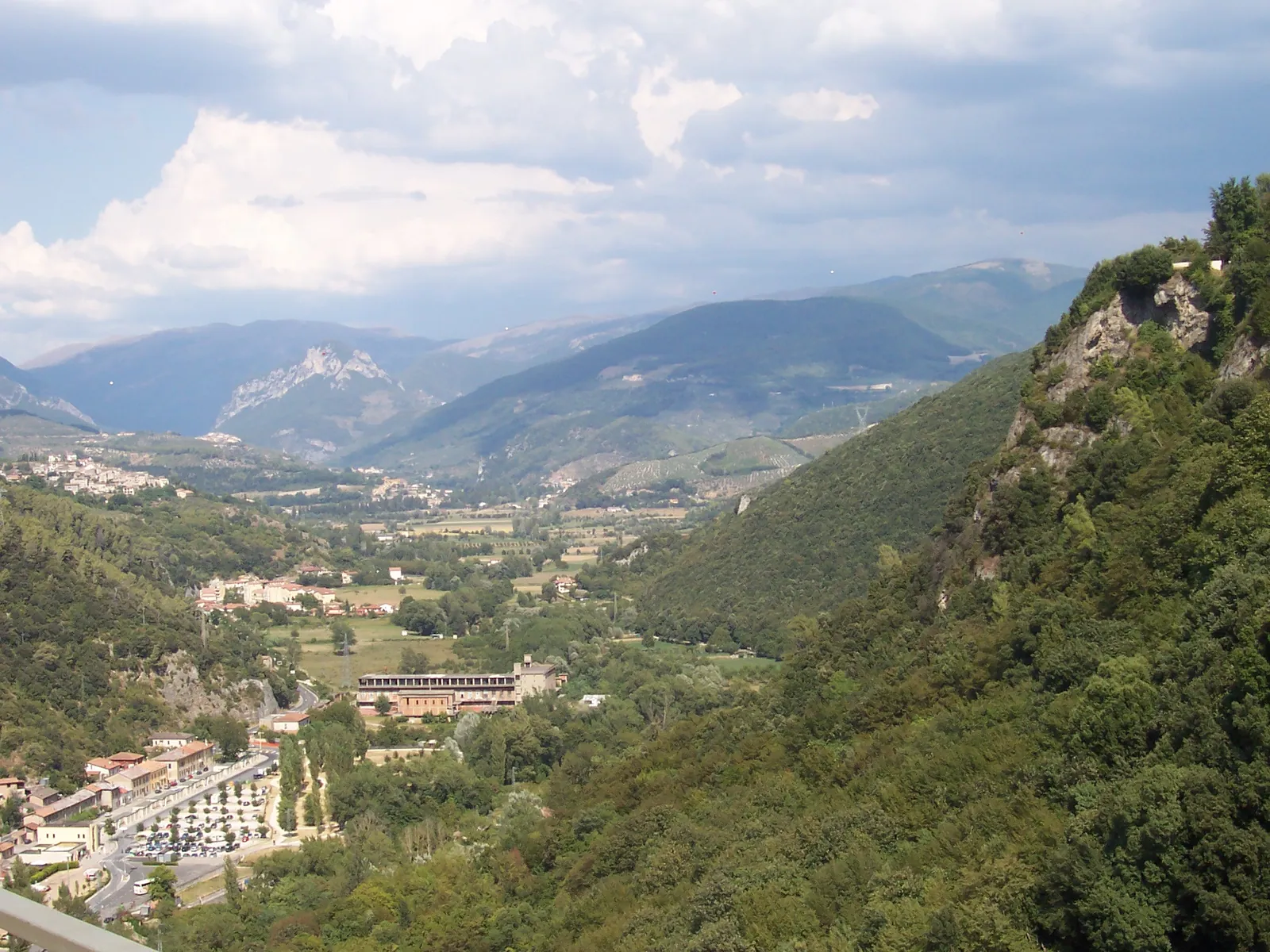
The Valnerina is the valley of the Nera river. The river rises in the Sibillini Mountains, in the Marche, crosses a narrow, winding mountain area in southeastern Umbria, reaches Terni and flows into the Tiber near Orte. The valley is divided among the provinces of Macerata, Perugia, Terni and Rieti. The most visited towns are Arrone, Ferentillo, Visso and Cerreto di Spoleto, and Norcia, Cascia and Leonessa are easy to reach from the valley. It is a stretch of the Umbria-Marche Apennines made of gorges, towers, bridges and hilltop villages, with a history tied to water.
In the Middle Ages the valley lay along an important route and was at the heart of the Duchy of Spoleto in the Lombard period. The abbey of San Pietro in Valle, near Ferentillo, dates from that time. In the 16th century an important school of surgery arose in Preci. In March 1944 the Brigata Garibaldi "Antonio Gramsci" partisan brigade created the first liberated zone in Italy between Arrone, Cascia and Leonessa. Farther down the valley, toward Terni, the water of the Nera fostered industrial development in the 19th and 20th centuries. In Papigno stand the large abandoned chemical plants that Roberto Benigni used to film the concentration camp scenes of Life Is Beautiful (La vita è bella).
Things to see in the Valnerina
The Cascata delle Marmore (Marmore Falls) is the best-known site in the lower Valnerina. It forms where the Velino river drops into the Nera, with a 165-meter fall divided into three parts. It is not a natural waterfall: the Romans created it in 271 BC to drain the waters of the Velino, which caused floods and marshes. The channel was commissioned by the consul Manius Curius Dentatus. Today the flow is regulated by a system of sluice gates, and the falls reach full flow only at set times. Before going, it is therefore worth checking the schedule of water releases. The falls park has six trails for viewing the cascades from different points. The Belvedere Inferiore (lower viewpoint) is reached on level ground, while the trails have sections with steps.
The abbey of San Pietro in Valle is about five kilometers from the village of Ferentillo. It was founded in the 8th century by Faroald II, Lombard duke of Spoleto, and is part of the UNESCO site "Longobards in Italy. Places of Power". The nave holds a cycle of Romanesque frescoes from the late 12th and early 13th centuries, whose restoration was completed in 1995. The church also preserves Roman-era sarcophagi. The former convent is privately owned and houses accommodation. The church was closed after the 2016 earthquake and reopened in March 2017. Today it can be visited only on request.
In the central part of the valley, near Sant'Anatolia di Narco, the valley floor widens into alluvial plains called Canapine, after the hemp (canapa) once grown there. Not far away stands Castel San Felice, with the abbey of Santi Felice e Mauro. According to the valley's best-known legend, two hermits from Syria, Felix and his son Maurus, freed the Valnerina from a dragon that plagued it with its foul vapors. The story is thought to recall the reclamation of the valley through water management. Continuing north are Vallo di Nera, Borgo Cerreto and Triponzo. Beyond Preci the road climbs toward Visso and toward Castelsantangelo sul Nera, where the river rises.
Religious tourism also matters a great deal in the Valnerina, especially in Cascia and Norcia. The 2016 earthquakes struck the whole area. For individual monuments, it is best to check their current status before a visit.
Nature and trails in the Valnerina
The Nera river is 116.2 km long. It rises near Vallinfante, a hamlet of Castelsantangelo sul Nera, inside the Sibillini National Park. Along its course it receives several tributaries: the Campiano near Ponte Chiusita, the Corno at Triponzo, the Vigi at Borgo Cerreto and the Velino at the Cascata delle Marmore. After Triponzo, thanks to the Corno, its flow more than doubles. The cool waters of the river and its tributaries also feed many trout farms.
In the Valnerina Ternana lies the Parco fluviale del Nera, a protected river park in the municipalities of Terni, Arrone, Montefranco and Ferentillo. The park follows the river for about 20 km, from the boundary between the provinces of Terni and Perugia to the Cascata delle Marmore. The Nera draws kayakers. Rafting, canyoning and hydrospeed are also offered in the falls park.
For cycling or walking there is the former Spoleto-Norcia railway. The line opened in 1926, closed in 1968, and since 2014 has been turned into a cycling and walking route. Along the route there are 19 tunnels and 24 bridges and viaducts. The section from Spoleto to Sant'Anatolia di Narco is 17.9 km long, with 380 meters of elevation change. By bike it takes about 2 hours, on foot much longer. The recommended season runs from spring to fall. The section includes a tunnel of almost two kilometers, followed by a winding descent toward the Valnerina. The tunnels are not lit, so lights on the helmet or bike are needed. After the 2016 and 2017 earthquakes some sections stayed closed for a long time and the Caprareccia tunnel was under maintenance: before setting out, check which sections are open. From Sant'Anatolia di Narco it is possible to join the Nera cycle route, which runs down the valley to the Cascata delle Marmore.
In the upper valley, the Sibillini Mountains are the main hiking destination. For high-altitude routes, the pages on the villages of the Sibillini Mountains are a good starting point.
Where to stay in the Valnerina
The valley is long, so it is best to choose where to stay based on the stops: the area of the Cascata delle Marmore and Ferentillo to the south, the Sant'Anatolia di Narco stretch in the center, Visso and the Sibillini to the north. Accommodation is listed on the pages of the individual villages, such as Cascia or Castelsantangelo sul Nera.
Where to eat in the Valnerina
Valnerina cooking revolves around truffle, which is so widespread here that it appears on restaurant and trattoria menus from appetizers to some desserts. The most typical dishes are strangozzi with black truffle (fresh pasta made only with water and flour), lamb with black truffle, trout with black truffle, scrambled eggs with truffle and crayfish. Also very common are penne alla norcina, with cream, sausage and pecorino, and soup made with Lenticchia di Castelluccio di Norcia IGP (PGI lentils). Trout is also used in pasta dishes, for example tagliolini with trout fillet.
Local products of the Valnerina
The Valnerina economy is based on farming, traditional sheep and goat herding, truffle gathering, trout farming and cured meat production. The norcinerie (pork butchers) make salame, capocollo, lonza and other cured meats. The most famous product is prosciutto di Norcia, a PGI (IGP) ham since 1998.
Three species of truffle grow in the Valnerina: the prized Norcia black truffle (tartufo nero pregiato), the summer truffle and the winter truffle. Black truffle, pork butchery and saffron are considered the valley's historic products, especially in the northern part. Every February Norcia hosts the Mostra Mercato del Tartufo Nero, the black truffle fair.
There are several protected-label products. Among them are the farro DOP (PDO spelt) of Monteleone di Spoleto, the IGP lentils of Castelluccio di Norcia and the pure saffron of Cascia. The cicerchia (grass pea) and the roveja (a wild pea) of Civita di Cascia are Slow Food Presidia. Cheeses include pecorino, ricotta salata della Valnerina and cheeses with Norcia black truffle or with Cascia saffron. Two species of trout live in the Nera, brown trout (fario) and rainbow trout (iridea).
Weather and how to get to the Valnerina
The main road is the SS 209 Valnerina, 88.69 km long. It starts in Terni and follows the Nera upstream: it passes the Cascata delle Marmore, below Arrone and Montefranco, crosses Ferentillo and enters the Marche as far as Visso. From there it turns toward Pieve Torina and joins the SS 77 near Muccia. In Umbria the road is now a regional road, except for the stretch between Sant'Anatolia di Narco and Triponzo, which is part of the SS 685 Tre Valli Umbre. From Spoleto, the valley is entered through the Forca di Cerro tunnel.
The main access routes are:
- From Rome and Florence: A1 highway, Orte exit, Orte-Terni link road.
- From Cesena and Perugia: E45 expressway to Terni.
- From Ancona: Via Flaminia toward Spoleto and Terni.
- From Rieti: expressway 79.
By train, the arrival point is Terni station, continuing by public transportation.
The stretch between Preci and Visso, in the area hit by the 2016 earthquake, had been cut by a large landslide. It was later reopened without restrictions. Check the weather forecast before setting out, especially for hikes in the Sibillini.