


The Apennine chamois in the Sibillini Mountains
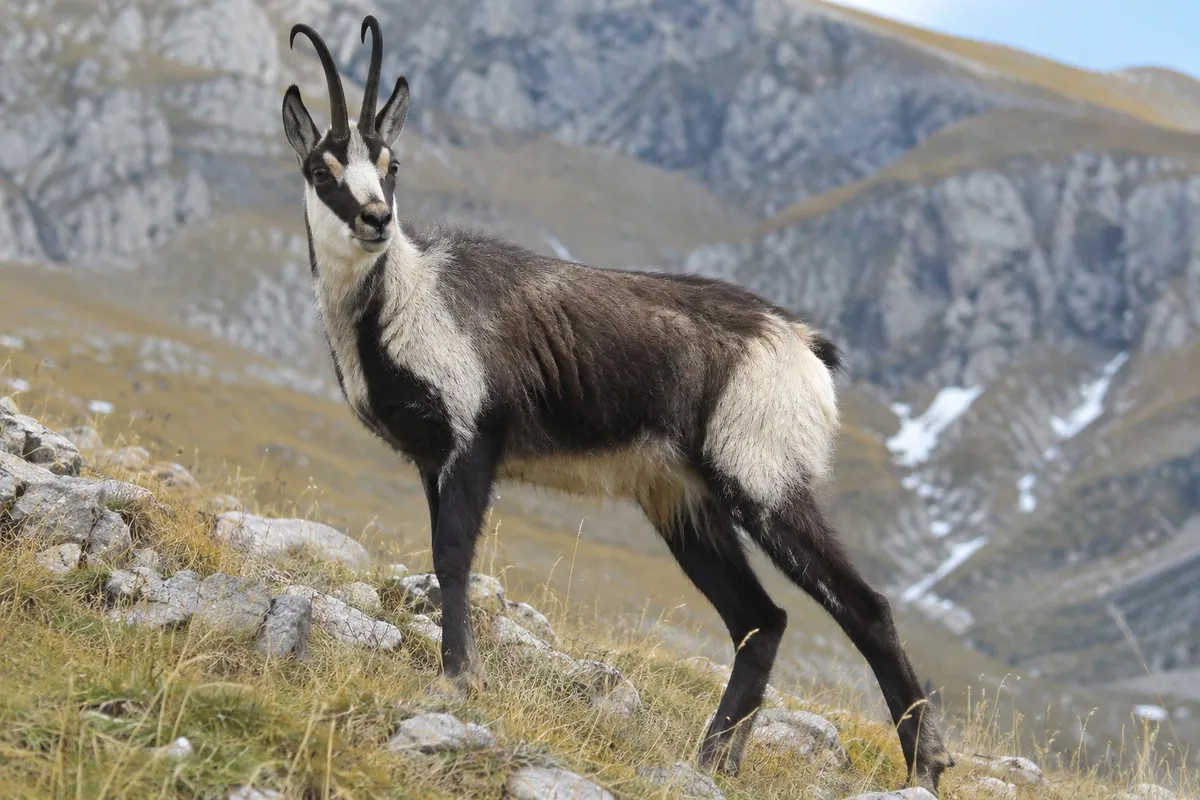
The Apennine chamois (Rupicapra pyrenaica ornata) returned to the Sibillini Mountains in 2008, when the National Park released the first animals on the Monte Bove massif. That small group grew into a fast-expanding colony, which the Park counts every year.
This subspecies, very ancient and found only in the central Apennines, was reduced in the twentieth century to a few dozen animals in a single area of what is now the Abruzzo, Lazio and Molise National Park. All of today's Apennine chamois descend from that group.
How to recognize the Apennine chamois
The Apennine chamois is between 110 and 130 cm long. Males can weigh up to 45 kg, while females stay between 30 and 35 kg.
Its most striking feature is the horns, carried by both males and females. They are more than 30 cm long, point upward and slightly forward and end in a tip curved backward like a hook: they are much longer than those of other chamois. They are never shed and grow every year, forming rings that reveal the animal's age.
The coat changes with the seasons. In summer it is light brown, tending to reddish. In winter the hair becomes longer and thicker and the pattern more contrasting: blackish brown on the back and legs, with large pale areas on the throat, head, neck down to the shoulders and hindquarters. In every season there is a dark band like a mask across the eyes and a pale patch on the throat.
Its hooves explain its sure footing on rock: they are split in two parts that can spread to an angle of 90 degrees, increasing the contact surface.
Group makeup also helps in understanding what you are watching. Females, kids and young animals of one or two years live in herds. Young males form small separate groups; as adults they live alone and join the herds during the rut, between November and December. Kids are born between May and June, one per female, after a gestation of 160-180 days.
Where the Apennine chamois lives in the Sibillini Mountains
The Apennine chamois lives high up: it favors areas above 1,700 meters, at the upper edge of the beech forests, where it uses grasslands and rocky slopes. It feeds almost only on grasses. In winter, when snow covers the high pastures, it moves lower in search of food.
In the Sibillini Mountains its stronghold is the Monte Bove massif, across Bove Nord, Bove Sud and Bicco: this is the release area and the one where most of the animals are concentrated. Since summer 2019 a herd has also used the southern slope of Monte Priora: in that year's census, 30 chamois were observed between Pizzo Berro and Monte Priora, 18 of them on the slope facing the Tenna valley.
The reintroduction took place under the LIFE Coornata project. The animals, fitted with radio collars, were released starting in 2008; about thirty were released in all, the number considered the minimum for a viable population. In 2010 the project received WWF's Golden Panda award. Since then the colony has grown: in 2019 the estimate was about 180 animals, and on November 7 of that year 123 were counted, the minimum certain number. Counts are always partial, however, because observation is difficult on the north side of Monte Bove.
The chamois is not a newcomer to these mountains. A skull found in a cave on the slopes of Monte Vettore, studied by the Università Politecnica delle Marche, is about 3,000 years old and proves that the species lived in the Sibillini in the past.
Despite its recovery, the Apennine chamois is still classified as “vulnerable” on the IUCN Red List. The current population also has very low genetic variability, a result of repeated population crashes.
When and where to see the Apennine chamois
On Monte Bove, encounters with chamois are not rare. The Park's E8 hiking route, fully waymarked, runs partly along the edge of the summer protection area for the chamois: it allows the animals to be observed without disturbing them. Until December 31, 2026, however, the route is closed even on foot under Comune di Ussita ordinance no. 48 of August 25, 2026, linked to the construction site of the Frontignano-Cornaccione gondola lift. Binoculars are needed, because the animals should be watched from a distance.
The chamois calendar offers some pointers. Kids are born between May and June. In summer the grasses it eats are plentiful on the mountain grasslands. Between November and December, during the rut, adult males join the herds and clash in fights that are sometimes violent.
Those who prefer not to tackle a high-altitude hike have two alternatives. At Bolognola there is a wildlife area of about 3 hectares where some chamois live in semi-freedom. In Fiastra the Park visitor center houses the Chamois Museum in Fiastra, a chamois museum with four rooms linked in a loop. Since the earthquake the Park has listed the museum as not open to the public because of minor structural damage, although guided tours were held there in 2025, and the information and welcome service is provided in a temporary building opposite: it is best to ask the Park for confirmation before going.
The census is a special opportunity. The Park counts the chamois every year and also involves volunteers: in 2026 the summer census took place on July 24.
Rules and responsible behavior
For Monte Bove the Park has issued specific rules to protect the chamois, in addition to the general rules of the protected area.
Protection areas. Since 2009 there have been two protection areas on the massif, one for the winter period and one for the summer. Before a hike or a climb on Monte Bove, check the rules in force on the Park website.
Dogs. Dogs are not allowed anywhere on the E8 Monte Bove route, not even on a leash. In the rest of the Park the rules in force since 2013 apply: dogs may not enter Zone A, the strict nature reserve, except on a leash along the official hiking routes where they are permitted, and elsewhere they must be kept on a leash. For wildlife a dog is a direct risk, because it can prey on animals, and an indirect one, through disturbance and possible disease transmission.
Distance and silence. If you spot a chamois, the Park asks you to stay still and quiet. Do not approach, do not leave the trail to follow the animals, and move in small groups, without noise.
Overflights. A helicopter passing over an area used by chamois is a severe disturbance that can scatter the animals: a helicopter rescue of two climbers nearly jeopardized the reintroduction, and in January 2009 the Park temporarily closed access to a limited rocky area of Monte Bove.
Litter. Leave nothing behind, not even organic scraps, which can alter the animals' habits.
For the Park's other animals, start from the page on Sibillini National Park wildlife or from the guide to the Apennine wolf; the general overview is in Sibillini flora and fauna.