


Lame Rosse: how to get there and trails
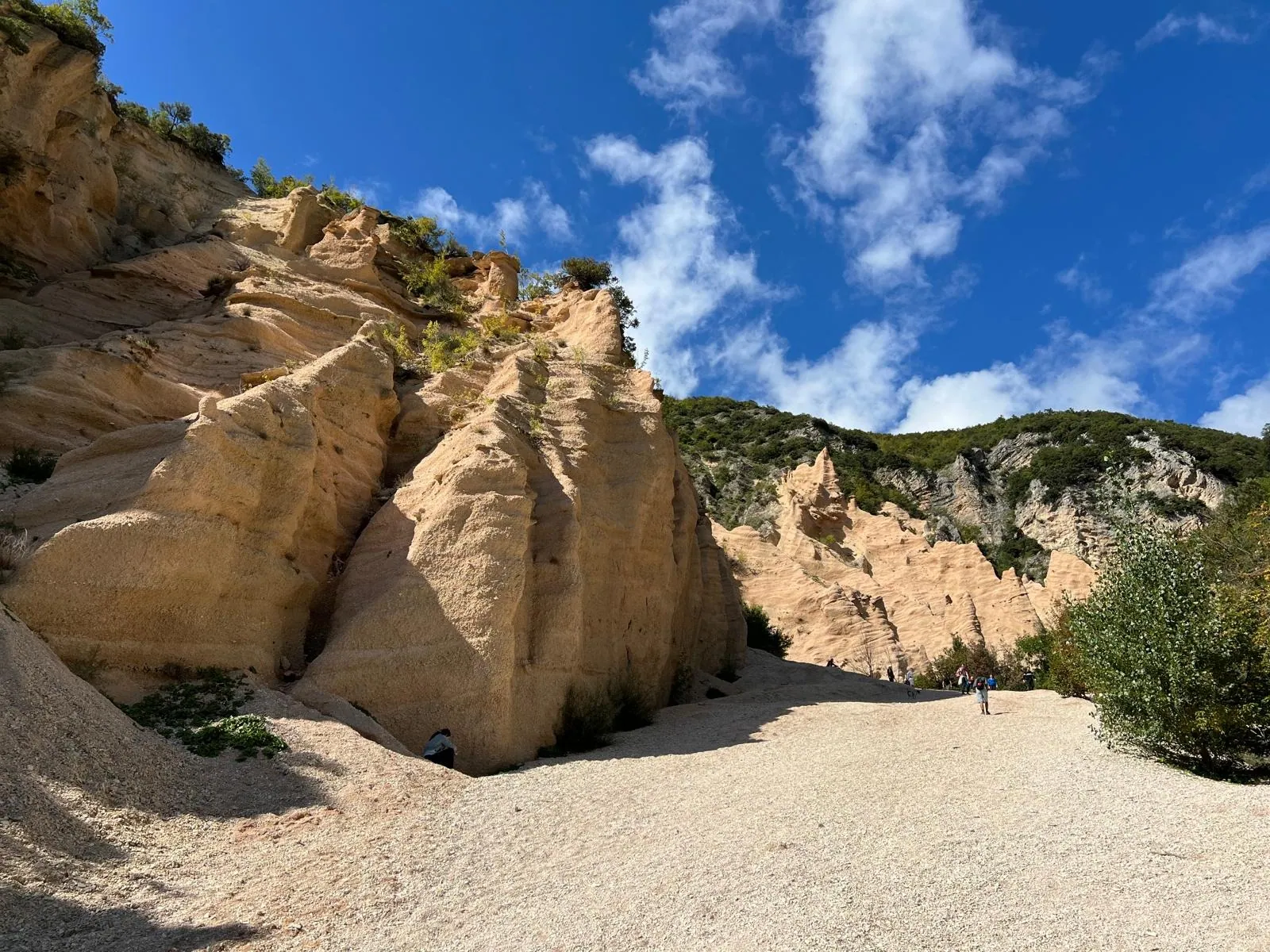
The Lame Rosse are a group of pinnacles, spires and small canyons of reddish sediment above Lago di Fiastra. They lie in the municipality of Fiastra, in the province of Macerata, within the Sibillini National Park in the Sibillini Mountains. No road reaches the foot of the cliffs: the Lame Rosse can only be reached on foot, on a marked trail that starts from the lake's dam. The way there takes about an hour of walking. The full route, out and back, is about 7 km, with about 300 m of elevation gain.
The red color comes from the source rock. The sediments are very angular fragments that broke away from older formations, mainly the Scaglia Rossa, and piled up at the foot of a steep slope. Erosion then carved them into badlands and pinnacles. These stay standing thanks to layers of cemented breccia that protect the softer material beneath them. The name also describes the place: in the dialect of the Sibillini, a "lama" is a steep, slippery wall made of unstable debris, and "lamare" means to slide or collapse. Along the way the woods alternate with brief glimpses of the lake, until the trail reaches a red landscape with an almost "Martian" look.
Before you go
Forecast
- Today11° / 6°0.3 mmPartly cloudy
Forecast by MET Norway, updated automatically · license CC BY 4.0
Rules and orders: Park website. Snow and avalanches: Meteomont bulletin.
On the map
Points from the site database. Map © OpenStreetMap contributors · Protomaps.
Where the Lame Rosse are located
The Lame Rosse are in the municipality of Fiastra (MC), above Lago di Fiastra, in the Valle del Fiastrone. The geosite lies between Monte Fiegni (1,323 m) and Monte Petrella (1,155 m). Lower down flows the Fiastrone River, which rises from the lake. Fiastra is the access point to the northern sector of the Sibillini National Park.
The Lame Rosse are in Zone A of the Park, the zone under full protection, where the Comune and the Park can restrict human activities to protect the environment. The formations are fragile and constantly changing through erosion. Climbing on the pinnacles is strictly forbidden, and it is best to always stay on the marked path.
Thanks to the abundance of water, the flora and fauna are very rich. The woods hold sessile oak, holm oak, hornbeam and dog rose, along with flowers and mushrooms that vary with the season. Hedgehogs, porcupines, squirrels and wild boar live in the undergrowth. There have also been rare sightings of the Apennine wolf and the wildcat. Birds of prey include the short-toed eagle, peregrine falcon, goshawk, eagle owl and little owl.
How to get to the Lame Rosse and where to park
The starting point for the Lame Rosse trail is the dam of Lago di Fiastra, at the northern end of the lake, which can be reached by car. From the Adriatic coast, follow signs for Macerata and then for the Sibillini Mountains, as far as the municipality of Fiastra and the village of San Lorenzo al Lago. From there, follow the signs for the dam. By car it takes about 45 minutes from Tolentino, an hour from Macerata and an hour and a quarter from Ancona.
In summer and on weekends, Lame Rosse parking is often the main problem of the day. Near the dam there is a small parking area with room for ten to fifteen cars, which fills up early. About 500 m from the dam, along the Strada Provinciale 91, there is a larger gravel lot used for parking. Other pull-outs can be found farther back along the same road. In several stretches, however, parking is prohibited: follow the signs and do not leave the car where it blocks traffic. On peak days it pays to arrive early.
Campervans cannot enter the dam parking lot. San Lorenzo al Lago has an equipped campervan area, but it is a long way from the trailhead.
Trails and hikes to the Lame Rosse
The classic trail to the Lame Rosse starts from the dam of Lago di Fiastra. It is marked E2 in the Park network and 335 in the CAI signage, and the return follows the same route as the way there. The difficulty grade is E (hiking). The route suits anyone with a minimum of fitness, children included, but hiking shoes are needed. There are no fountains or refreshment points along the trail: water and food must be brought along. Allowing for the way there, the way back and breaks, the hike takes on average two and a half to three hours.
The hike begins by crossing the dam on foot, with the lake on one side and the Fiastrone valley on the other. It then passes through a short tunnel, part of the hydroelectric plant, and climbs to a junction, where the trail keeps right. A wide dirt track drops slightly and leads into the relict holm oak wood of the Fiastrone, a forest left over from the last ice age. The trail is shaded, but in summer it is still hot in the middle of the day. Farther on, ignore the turnoff to the right for the Gole del Fiastrone. For the first few kilometers the Lame Rosse stay hidden by the trees and only come into view at the end.
The last stretch starts at a junction with signs and a notice board, in the Fosso della Regina. It is a steep scree slope a few hundred meters long, where the gravel slides underfoot. This is the most tiring part of the route, and on the way back the descent requires care, especially for less experienced hikers. Those with less training will find trekking poles useful. The trail ends right below the cliffs.
Ordinance no. 39 of July 28, 2022 of the Comune di Fiastra regulates the use of the trails of the Lame Rosse, the Grotta dei Frati and the Gole del Fiastrone: before setting out, it is advisable to check on the Comune's website with what restrictions the trail can be walked. Dogs are allowed.
From the base of the Lame Rosse, trail 335 continues to the Grotta dei Frati, a cave hermitage. This stretch is steep, takes about an hour and is slippery in places. The full route dam – Lame Rosse – Grotta dei Frati, returning to the dam, is about 10 km and about 5 hours of walking. There are also other starting points, for example from Ruffella, near Fiegni, or from the Belvedere di Fiastra.
Some trails in the area are closed. Access to the Gole del Fiastrone is forbidden to everyone by ordinance of the Comune di Fiastra, as the Park also states, and according to the Park the section from the Grotta dei Frati to Monastero cannot be walked. The trail from the Valle di Nicola to the Fosso della Regina is closed as well. Before setting out, check the status of the trails on the Park's official channels.
Environmental guides also lead guided hikes. Some reach the Lame Rosse in the late afternoon and return after dark with headlamps.
Best time to visit the Lame Rosse
The Lame Rosse can be visited all year round and the trail is open in winter too. Snow is the exception: in those conditions the pinnacles are unstable and it is better to give up. Late spring is the most pleasant time for walking, before the summer heat. In fall the woods change color. In summer it is better to start early, because it is hot in the middle of the day even in the holm oak wood.
The time of day matters too. In the morning the sun lights up the rocks and the colors are brighter. In the afternoon the cliffs fall into shade. Late afternoon has another advantage, though: it is quieter, and it is the time chosen for the guided sunset outings.
In recent years the Lame Rosse have become very popular. In 2021 the Comune di Fiastra estimated that visitors had grown from about 8,000 to almost 40,000 per season. In summer and on weekends there are more people on the trail and fewer parking spaces.
Access to the Lame Rosse is open and free, with no ticket, reservation or visitor cap. In 2021 an ordinance of the Comune di Fiastra had introduced a paid ticket and a limit of 600 people per day, but the Comune revoked it on July 6, 2021. Before setting out, it is still worth checking for any updates on the official channels of the Comune and the Park.
What to see near the Lame Rosse
Lago di Fiastra is the natural stop before or after the hike. It is a reservoir of about 2 km², created to generate electricity with the waters of the Fiastrone, a tributary of the Chienti. The left shore is steeper and wooded. On the right, the Sentiero della Natura runs along the lake for about 3 km and is also a traffic-free bike path. Bikes can be rented in San Lorenzo al Lago. There are free beaches near the parking lot. Water shoes are useful for getting into the water among the stones.
The Grotta dei Frati lies on the south side of Monte Fiegni, on a rock face above the Gole del Fiastrone. It is a complex of three karst caves. For centuries Benedictine monks lived there, and around 1200 the Clareni friars settled there. The site was abandoned in the 17th century. Today the remains of the walls, a stone altar, the stairs to the upper level and the rainwater cistern can be seen. Inside the cave is the small church built by the friars, first dedicated to Sant'Egidio and later called Santa Maria Maddalena de Specu. During World War II the cave served as a hideout for partisans.
The Gole del Fiastrone cannot be walked, but the dam offers a good view of the valley: the wild valley can be seen ending in two rock spurs above the narrows of the gorge.
Fiastra has the remains of the castle of the Magalotti counts, on top of the hill above the lake and along the route of the Grande Anello dei Sibillini. The village is also home to the Casa del Parco, a park visitor center, with the Chamois Museum, the chamois museum.
Frequently asked questions
Where are the Lame Rosse?
How do you get to the Lame Rosse and where does the hike start?
Where do you park for the Lame Rosse?
Where can you eat at the Lame Rosse?
How do access and opening hours work for the Lame Rosse?
How long does it take to visit the Lame Rosse?
What is the best time to visit the Lame Rosse?
Nearby
What to see nearby
- Grotta dei FratiCave1.3 km
- 2.0 km
- 2.7 km
Where to stay
- 2.4 km
- 3.6 km
- R&B Camping, FiastraCampground4.0 km
Where to eat
- Il Camoscio Pizzeria Ristopub, FiastraRestaurant4.1 km
- Verdefiastra, Lago di FiastraBar and café4.1 km
- La Dolce Vita di Emma Gelateria, FiastraIce cream shop4.2 km
Straight-line distances.