


The Guerin Meschino legend
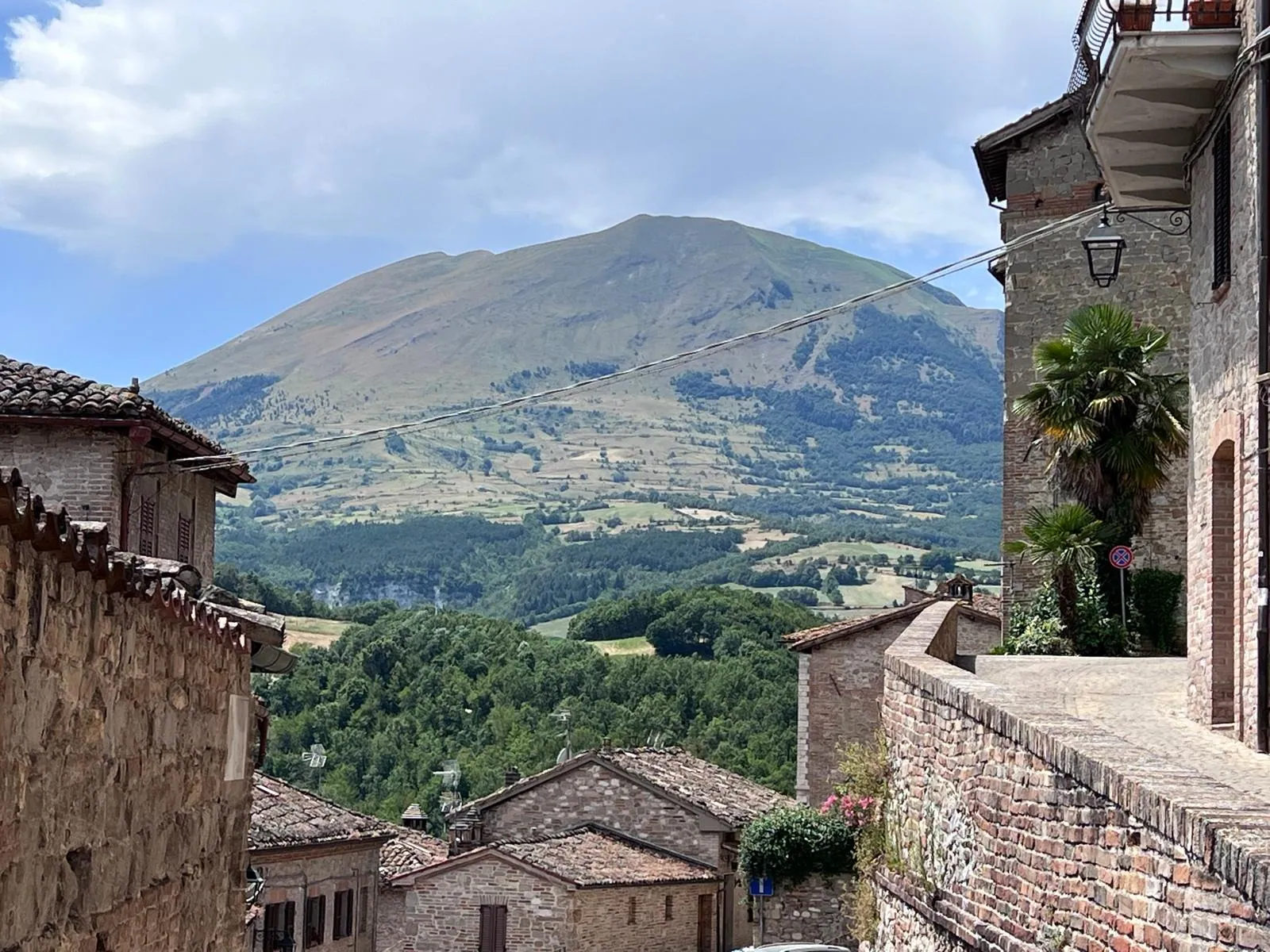
The Guerin Meschino is a chivalric prose romance that Andrea da Barberino completed around 1410, and the most famous episode of the legend takes place in the Sibillini Mountains. The hero, Guerino, seeks the Sibyl in the cave on Monte Sibilla, on the Montemonaco side, because only she can tell him who his parents are. The story is set in the year 824. It helped fix the image of the Apennine Sibyl as a sorceress and queen of an underground world, discussed on the page devoted to the Apennine Sibyl.
Anyone following in Guerino's footsteps finds places with names that seem to come straight out of the tale: Pizzo del Diavolo (Devil's Peak), Cima del Redentore (Redeemer's Peak), Passo Cattivo, the Gole dell'Infernaccio, Lago di Pilato, the Grotta delle Fate. This page sums up the plot, explains where the tale comes from and shows how to visit the places that recall it today.
Guerin Meschino legend: what to know
The story in brief. Guerino is a knight at the court of Constantinople. He is called "meschino" (wretched) because he does not know his parents, and so he sets out in search of his origins. He travels much of the world then known, performing heroic deeds. At one point a wise old man tells him that in the middle of Italy a Sibyl still lives, the only one able to answer his questions.
In the fifth book Guerino reaches the Sibillini Mountains, which at the time were called the Monti di Norcia. He sets off from Norcia toward the grotta della Sibilla to ask the names of his parents. The tale has come down in eight books.
The underground kingdom. The Sibyl's court is a world of pleasures, but it has a dark side. Every Friday at midnight its inhabitants turn into snakes and other monstrous creatures. They take human form again at midnight on Saturday. The Sibyl holds Guerino back and tries to lead him into sin.
The hero asks again and again for news of his origins, but receives only refusals. When almost a year has passed, the limit beyond which no one can leave that world, he leaves the cave. He then goes to Rome to ask the Pope for forgiveness. In the romance the sorceress is also called the fairy Alcina, a name still often used in the Sibillini for the Sibyl.
Author and text. Andrea da Barberino was a Tuscan man of letters from Barberino Val d'Elsa, born around 1370 and died after 1431. The hero's name changes from edition to edition: Guerino, Guerrino, Guerin or Guerrin. The work circulated in manuscript for a long time. The first printed copy came out in Padua on April 21, 1473.
The tale also ran into trouble with church censorship. A Venetian edition of 1785, reprinted in many modern editions, removed every reference to the Apennine Sibyl and replaced her name with circumlocutions such as "incantatrice" (enchantress).
The comparison with La Sale. The Guerin Meschino is one of the two texts that define the Sibyl as she is known today. The other is Il Paradiso della Regina Sibilla by Antoine de La Sale, from 1420. The description of the court is very similar in the two books. To learn more, see the page on Antoine de La Sale and the Paradise of Queen Sibyl.
Cultural echoes. The legend of the Meschino resembles the one from which Richard Wagner drew his opera Tannhäuser. In everyday Italian, the "giro del Meschino" (the Meschino's tour) means a roundabout way of reaching a goal. The other creatures of the underground world are described in the fairies and necromancers of Sibillini legend. The full list of tales is on the page Legends of the Sibillini Mountains.
Where it sits in the landscape. The grotta della Sibilla opens below the summit of Monte Sibilla, on the Montemonaco side. According to tradition, Guerino climbed along a high-altitude path. It starts from a steep rocky saddle below the Sibyl's "Corona" (crown), and descends toward the Gole dell'Infernaccio.
The cave cannot be visited today. Its entrance collapsed in the 20th century, partly because of some attempts to force it open with explosives, and the cavern has remained inaccessible. The hiking route reaches the remains of the entrance, marked as a blocked cave.
Guerin Meschino legend: the places of the story today
The story can be read and explored at any time of year. For walking through the places of the tale, the right period runs from summer to fall.
In spring there may still be snow at altitude. Even at the end of April, the hollow where the cave entrance used to be can be covered in snow.
In summer, traffic on the dirt road to the Rifugio Sibilla (a mountain hut), the starting point of the hike, may be restricted. In that season a shuttle service runs there. It is worth asking in advance how the service works and about road conditions.
Guerin Meschino legend: practical tips
The hike through the places of the Meschino. The most direct route to the cave is the Monte Sibilla loop. It is a circular route of about 12 km, with about 710 m of elevation gain. It takes between 4 and 5 hours of walking. The difficulty grade is EE, for expert hikers, and it is recommended for those with good mountain experience.
Start and route. The trail starts from the Rifugio Sibilla, at about 1,540 m. From Montemonaco, follow the road toward the Gole dell'Infernaccio and then the dirt road that climbs to the hut. The way up follows CAI trail 155 along the southwest ridge to the "Corona", a band of rock fitted with chains. A little farther on are the remains of the cave and then the summit of Monte Sibilla, at 2,173 m. The return descends on CAI trail 156 along the west ridge, down to the dirt road near the hut.
Shuttle or on foot. In summer, the shuttle from Montemonaco can be used up to the hut. Alternatively, the dirt road can be walked. Climbing on foot adds considerably to the route, both in distance and in elevation gain.
What to know before setting out.
- Much of the route runs along the ridge. It is not recommended for anyone who suffers from vertigo.
- The climb to the "Corona" requires using the chain for support.
- The stepped section descending from the summit toward Cima Vallelunga is exposed in places, and loose stones on the rock slabs make it slippery.
- There are no water sources along the route, and the slope is exposed to the sun all day. Bring enough water.
- After the 2016 earthquake the Rifugio Sibilla stayed closed for a long time. It is best to rely on your own food and to check the condition of the road and the hut in advance. As with any high-altitude hike, check the weather before setting out.