


Norcia: what to see, where to stay and eat
At a glance
- Municipality
- Norcia
- Province
- Perugia
- Region
- Umbria
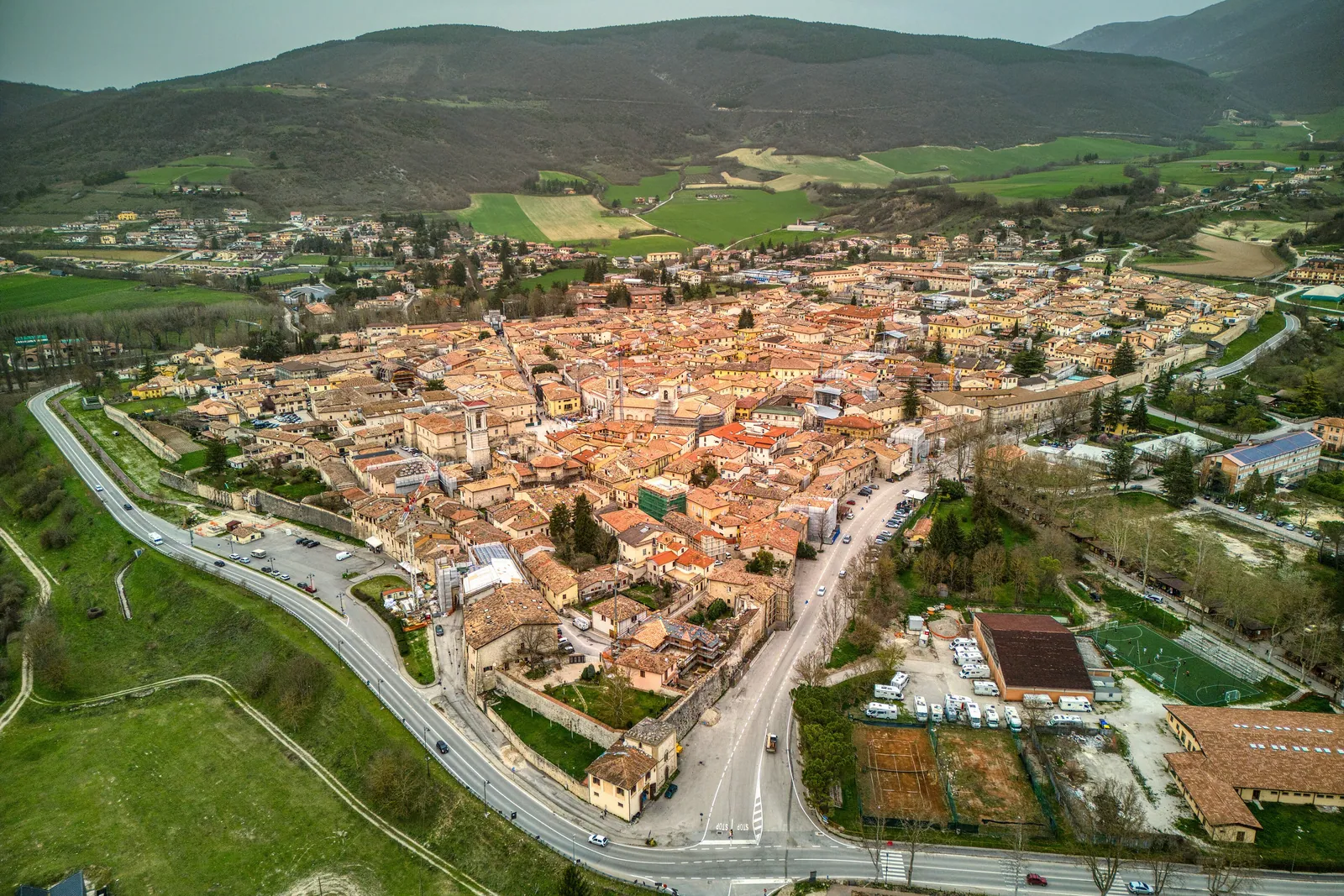
Norcia is the easternmost town of Umbria. It lies in the province of Perugia, at about 600 meters above sea level, on the northern edge of the Santa Scolastica plateau, inside the Sibillini Mountains National Park and close to the borders with Lazio and the Marche. Two different landscapes meet here. On one side is the Valnerina, the narrow valley of the Nera river with steep wooded slopes. On the other are the Sibillini, with peaks above 2,000 meters, beech forests and vast karst plateaus used for grazing. The municipality has 4,391 inhabitants and is 96 km from Perugia.
Norcia is the birthplace of Saint Benedict, patron saint of Europe. Its history is long and marked by earthquakes. Probably founded by the Sabines in the 5th century BC, it keeps an almost intact circuit of walls and a historic center largely from the 19th century, rebuilt after the earthquakes of the 18th century. After the 1859 earthquake, buildings taller than three floors were banned. The most recent wound dates back to October 30, 2016, when a magnitude 6.5 earthquake destroyed 80% of the structure of the Basilica of San Benedetto in Norcia, leaving only the facade standing. Today the basilica has been rebuilt, while other monuments in the center are still under restoration. A visit to Norcia combines the historic center under reconstruction, the tradition of norcineria (pork butchery and curing) and the trails that climb toward the Piano Grande di Castelluccio.
On the map
Points from the site database. Map © OpenStreetMap contributors · Protomaps.
What to see in Norcia
The heart of the visit is Piazza San Benedetto, dominated by the Castellina, the fortress designed by Vignola. The square is also home to the Basilica di San Benedetto (built on the remains of the birthplace of Saints Benedict and Scholastica), the Portico delle misure, the Co-Cathedral of Santa Maria Argentea and the Palazzo Comunale (town hall).
The Basilica di San Benedetto is open again. The basilica reopened on October 30 and 31, 2025, exactly nine years after the quake. Only the facade of the church had survived. Today the whole body of the church has been rebuilt. The roof, destroyed along with most of the load-bearing walls, has been rebuilt in pleated wood. In the crypt, the floor, smashed by the fall of the bell tower, was lifted and relaid stone by stone.
The Palazzo Comunale, a building of medieval origin, has also been restored. The official inauguration on April 19, 2026 closed an unusual building project: 67 seismic isolators, technological devices that physically separate the building from the surrounding ground, were inserted under the foundations.
The Museo civico e diocesano della Castellina, on the other hand, is still closed. The building was built in 1554 to a design by Jacopo Barozzi da Vignola; from 1860 it housed the town offices and in 1967 it became the seat of the museum. Restoration and seismic upgrading work on the museum, closed since the earthquake, is under way: the reopening date is uncertain, so it is best to check before visiting.
The Concattedrale di Santa Maria Argentea was also destroyed by the earthquake of October 30, 2016. Reconstruction work began on September 7, 2024, and the reopening has not yet been announced. Before planning a visit, it is best to check whether the church has already reopened.
The walls are crossed through the historic gates. The most monumental is Porta Romana, where Corso Sertorio begins. Churches and monuments are covered in more detail on the page things to do in Norcia.
Nature and trails near Norcia
The easiest route starts right from the center: the Marcite, the irrigated meadows just outside the walls. Here water from karst springs is collected and distributed by a network of channels that floods the land for long periods of the year. The marked route is 2.7 km round trip, easy, takes up to 2 hours and is entirely flat. Along the way are the channels, the old mills and the ancient perennial meadows created by Benedictine monks. The path starts from Porta Romana and passes near a water mill with horizontal paddles, now restored and open by appointment. In the same area stands the rural church of the Madonna di Cascia, built in 1477 for the solemn peace agreed between Norcia and Cascia.
For keen walkers there is the stretch of the Sentiero Italia linking Norcia to Castelluccio. The route crosses the Valle del Patino and is graded medium difficulty: distance 14.6 km, duration 5 hours and 25 minutes, elevation gain of over 1,000 m, with the highest point at 1,748 meters.
The Pian Grande, the largest of the Castelluccio plains, is about 7 km long from north to south and on average 3 km wide. The village of Castelluccio di Norcia is reached by car from Norcia (about 28 km, 40 minutes) on the SP477. The flowering of the fields takes place from late May to mid-July, but it has no fixed date because it depends on the weather. On flowering weekends access is regulated: cars are left in the parking lots up on the plateau and visitors continue by shuttle.
To the south, the Cammino di San Benedetto begins. The first stage runs through the Valle di Santa Scolastica and crosses a small pass between Norcia and Cascia; the highest point of this route is at about 1,000 meters. For high-altitude hikes, it is wise to check the weather before setting off.
Where to stay in Norcia
There are three main areas to stay in Norcia. The historic center is convenient for getting around on foot among squares and restaurants; the borgo outside the walls and the nearby neighborhoods are more practical for parking; the countryside and the hamlets are quieter. Those staying inside the walls should take the ZTL (limited traffic zone) into account and ask the property about loading and unloading luggage. The full list is on the page where to stay in Norcia.
Where to eat in Norcia
At the table the star is black truffle, which can be found out of season too because it is preserved. It is eaten on bruschetta, in pasta or over eggs. Alongside truffle there are the cured meats and legumes described below. Addresses are gathered on the page Norcia restaurants.
Local products of Norcia
Norcia's best-known products are the IGP prosciutto, the Norcia black truffle (tartufo nero pregiato) and the Castelluccio lentils IGP. The tradition of cured meats began in the early Middle Ages: in a subsistence economy, pork processed and sold to nearby towns became a source of income for farmers. In the 20th century, norcini (pork butchers) who emigrated to Rome opened many shops, which is where the word "norcineria" comes from.
Prosciutto di Norcia IGP is pear-shaped. The fresh ham must weigh at least 8.5 kg, and only hams meeting the requirements receive the IGP mark branded on the rind. Local specialties also include Pecorino di montagna di Norcia, a mountain sheep's cheese, and Monti Sibillini honey.
Truffle has its own event, Nero Norcia, the truffle festival, the national market fair of black truffle and local products. In 2026 it was held between February and early March, with about 60 stalls spread across the historic center. Shops and specialties are described on the page Norcia food: norcinerie and local products.
Weather and how to get to Norcia
Norcia's climate has always been cold: already in Roman times Virgil called it "frigida". The roads to get there are scenic and should be driven with care, especially in winter.
By car from the north, follow the A1 toward Perugia, Assisi and Spoleto. From Spoleto take the road to Norcia, 45 km long: the Forca di Cerro tunnel is recommended. Exit at Sant'Anatolia di Narco and continue toward Norcia and Cascia along the SS 209 Valnerina road. From Rome, leave the A1 at the Orte toll booth and continue toward Spoleto. In all, it is about 158 km by road from Rome to Norcia. From the Adriatic coast, exit the A14 at San Benedetto del Tronto and take the expressway to Ascoli Piceno, and from there continue to Norcia.
There are also daily buses from Rome (Stazione Tiburtina) and from Spoleto. The recommended airport is Rome-Fiumicino, about 200 km away. On arrival, cars are left in the parking lots just outside the walls.
In this section
5 results
 Things to do in Norcia18 places
 Where to stay in Norcia69 places to stay
 Where to eat in Norcia45 places
- Norcia Food28 places to stay
- Serravalle di NorciaUmbria · Perugia
No results with these filters.