


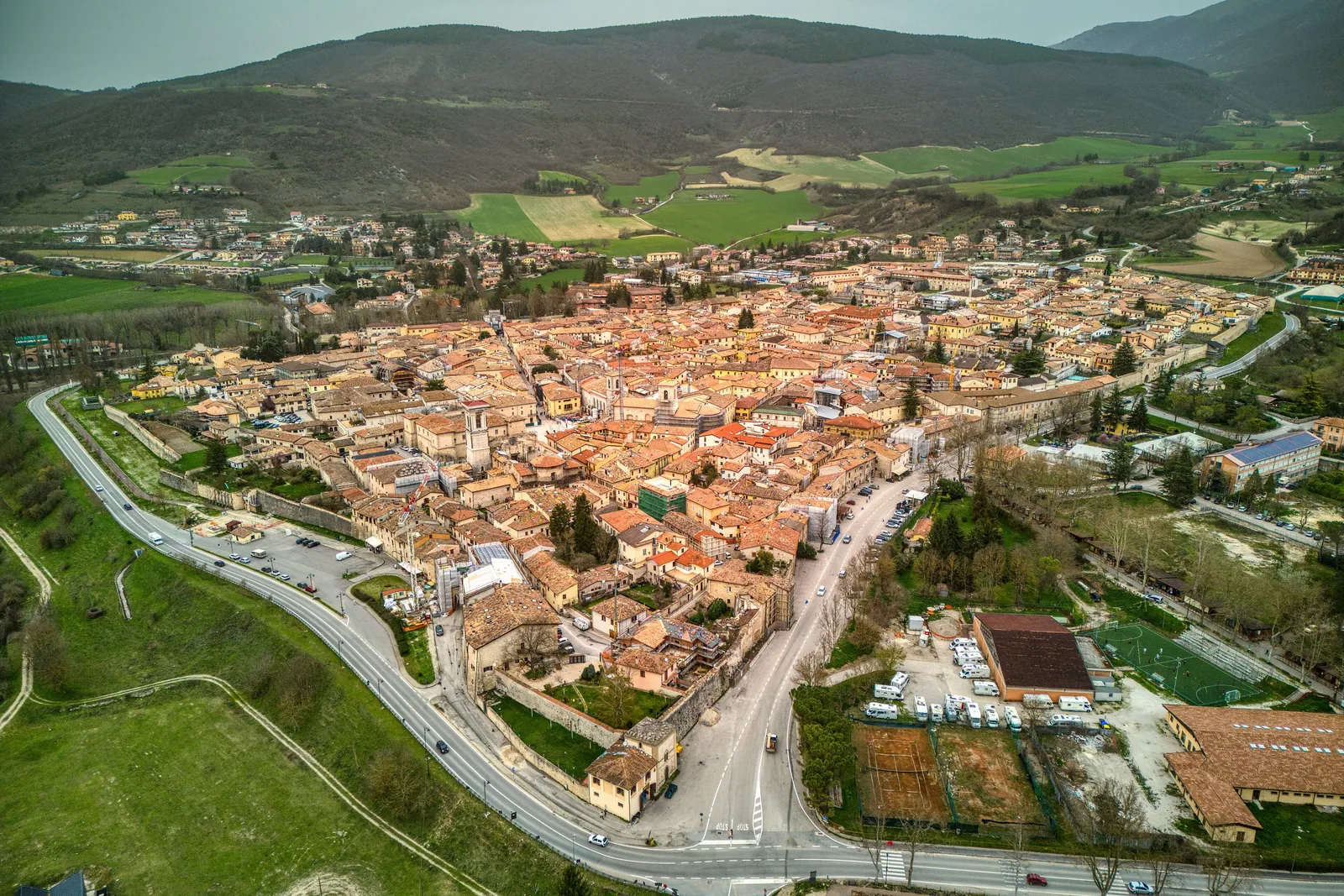
Where to eat in Norcia: restaurants
Photo: Hagai Agmon-Snir حچاي اچمون-سنير חגי אגמון-שניר / CC BY-SA 4.0 / Wikimedia Commons
Every Norcia restaurant draws on a larder with few equals in the Apennines: Prosciutto di Norcia IGP, Norcia black truffle, sausages made by master norcini (pork butchers), sheep's milk ricotta and Castelluccio IGP lentils, grown on the Pian Grande. To understand where to eat in Norcia today, though, it also helps to know the town's recent history. After the 2016 earthquake, many restaurants left the historic center and moved to new premises outside the walls, some of them in the buildings put up near Porta Romana. In Castelluccio, by contrast, the village restaurants were brought together in a single building below the village, called the "Deltaplano".
The return inside the walls has begun. In March 2025 Granaro del Monte, run by the Bianconi family since 1850, moved back to its historic home. Alongside the best-known names there are agriturismi (farm restaurants), osterie, trattorie, pizzerias, cafés, a gelato shop and a Michelin-starred restaurant. That makes it possible to plan a quick break between sights or a long dinner devoted to truffles.
The addresses
45 results
- RestaurantNemo, NorciaRestaurant · Norcia · 500 m from the center
- RestaurantBeccofino, NorciaRestaurant · Norcia · 600 m from the center
- Bar and caféVia Vai Caffè, NorciaBar and café · Norcia · 600 m from the center
- RestaurantPane e Pizza San Benedetto, NorciaRestaurant · Norcia · 600 m from the center
- RestaurantMaiale Brado di NorciaRestaurant · Norcia · 700 m from the center
- RestaurantTaverna del boscaiolo, NorciaRestaurant · Norcia · 700 m from the center
- RestaurantLocanda del Teatro, NorciaRestaurant · Norcia · 800 m from the center
- Pub and breweryMonkey Pub, NorciaPub and brewery · Norcia · 800 m from the center
- Bar and caféBar Caffè Tancredi di Rendina Alberto, NorciaBar and café · Norcia · 800 m from the center
- RestaurantSalsiccia Bar, NorciaRestaurant · Norcia · 800 m from the center
- Bar and caféBar d'Angelisa, NorciaBar and café · Norcia · 800 m from the center
- RestaurantGranaro del Monte, NorciaRestaurant · Norcia · 800 m from the center
- Fast food and street foodPinko Panino, NorciaFast food and street food · Norcia · 800 m from the center
- RestaurantIl Cenacolo, NorciaRestaurant · Norcia · 800 m from the center
- Ice cream shopGelateria da Benito, NorciaIce cream shop · Norcia · 800 m from the center
- RestaurantOsteria Senti 'n Puó, NorciaRestaurant · Norcia · 800 m from the center
- RestaurantOfficina, NorciaRestaurant · Norcia · 800 m from the center
- Bar and caféBar Bramont, NorciaBar and café · Norcia · 800 m from the center
- RestaurantCantina de Norsia, NorciaRestaurant · Norcia · 800 m from the center
- Bar and caféCaffè Parigi, NorciaBar and café · Norcia · 800 m from the center
- Bar and caféDelizia, NorciaBar and café · Norcia · 800 m from the center
- RestaurantVespasia, NorciaRestaurant · Norcia · 900 m from the center
- Bar and caféIl Chiosco, NorciaBar and café · Norcia · 900 m from the center
- RestaurantCantina 48, NorciaRestaurant · Norcia · 1.0 km from the center
- Bar and caféBar Roma, NorciaBar and café · Norcia · 1.2 km from the center
- RestaurantRistorante Taverna de' Massari, NorciaRestaurant · Norcia · 1.2 km from the center
- RestaurantTrattoria dei Priori, NorciaRestaurant · Norcia · 1.2 km from the center
- RestaurantAgriturismo La Tana Dei LupiRestaurant · Norcia · 1.4 km from the center
- RestaurantAntica Norceria, NorciaRestaurant · Norcia · 1.5 km from the center
- RestaurantValle del Sole, NorciaRestaurant · Norcia · 5.1 km from the center
- RestaurantRistorante da Pietro, NorciaRestaurant · Norcia · 6.3 km from the center
- Bar and caféIl Bar di Campi, NorciaBar and café · Norcia · 6.4 km from the center
- Bar and caféBar Italia, NorciaBar and café · Norcia · 6.5 km from the center
- Bar and caféRomcaffè, NorciaBar and café · Norcia · 7.0 km from the center
- RestaurantRifugio Perugia, NorciaRestaurant · Norcia · 7.0 km from the center
- Bar and caféGabry Bar, NorciaBar and café · Norcia · 7.6 km from the center
- Fast food and street foodIl Chioschetto del Pian Grande, NorciaFast food and street food · Norcia · 7.7 km from the center
- RestaurantRistorante Cioccora & Misterino, NorciaRestaurant · Norcia · 9.3 km from the center
- RestaurantAgriturismo il sentiero delle fate, NorciaRestaurant · Norcia · 9.9 km from the center
- RestaurantAgriturismo Il Guerrin Meschino, NorciaRestaurant · Norcia · 9.9 km from the center
- RestaurantOsteria Lu Soccio, NorciaRestaurant · Norcia · 9.9 km from the center
- Bar and caféBar Sibilla, NorciaBar and café · Norcia · 10.0 km from the center
- RestaurantTaverna Castelluccio, NorciaRestaurant · Norcia · 10.0 km from the center
- RestaurantOsteria del Vettore, NorciaRestaurant · Norcia · 10.0 km from the center
- RestaurantRistorante da Mamma Ida, NorciaRestaurant · Norcia · 10.0 km from the center
No results with these filters.
On the map
Points from the site database. Map © OpenStreetMap contributors · Protomaps.
Where to eat in Norcia: areas and restaurants
When choosing where to eat in Norcia, it helps to think by area. There is the historic center inside the walls and the areas just outside the gates, where many restaurants moved after the 2016 earthquake. Then there is Castelluccio di Norcia, the hamlet at an elevation of 1,452 meters overlooking the Pian Grande. Add to these the agriturismi across the municipality and the places for a quick stop.
In the historic center, the oldest name is Granaro del Monte. The Bianconi family has run it for over 175 years and presents it as the oldest restaurant in Umbria. The building was badly damaged by the earthquake and the restaurant operated for years from another location. It returned inside the walls when it reopened on March 29, 2025, together with the hotel Casa Bianconi in Norcia (the former Hotel Grotta Azzurra), which faces the main street and Piazza San Benedetto. The renovation preserved the six 16th-century dining rooms, finished with lime plaster and handmade terracotta.
A few meters from Piazza San Benedetto is Vespasia, Norcia's Michelin-starred restaurant, housed in Palazzo Seneca. The palazzo was built in the 16th century by the Seneca family, originally from Piedivalle, near Preci. It later became the Hotel della Posta, where travelers crossing the Apennines on horseback or by carriage would stop. Vespasia has kept its star to this day and has its own entrance, separate from the hotel's. It is a member of Relais & Châteaux and of the Ristoranti del Buon Ricordo. In the kitchen, chef Fabio Cappiello offers tasting menus based on local products such as Norcia black truffle and Castelluccio lentils.
Outside the walls are many of the restaurants that left the center after the earthquake. Three areas near Porta Romana and one near Porta Ascolana were chosen to relocate them. At Porta Romana, new buildings were handed over to five restaurants. Beccofino in Norcia also moved from the historic center to a modern building a short walk from Porta Ascolana, in an area where parking is easy. Alessia Ridolfi runs the kitchen, while her children Gianmarco and Francesca look after the dining room. The menu follows the seasons and centers on black truffle, with homemade pasta and dishes such as potato cappuccino.
Norcia also has Taverna de' Massari. It opened in 1989 on the initiative of Franco Gregori, still belongs to the Gregori family and is now led by chef Emiliano. The restaurant has an outdoor terrace. The menu offers truffle dishes, grilled meats and pizza, and the wine cellar holds more than 80 regional and national labels.
Castelluccio di Norcia was devastated by the 2016 earthquake sequence. The village's businesses were moved into the Deltaplano, a building of about 1,500 square meters built just below the village, overlooking the Pian Grande. When it opened, it housed eight restaurants, a café and a free-flight association. Restaurants in Castelluccio include Taverna Castelluccio and Osteria del Vettore. The cooking at Taverna Castelluccio focuses on truffles, lentils, cheeses and mushrooms, but also lamb, beef fillet and scottadito (grilled lamb chops). Also in Castelluccio is Agriturismo il sentiero delle fate, a wooden building with a restaurant, a dairy (where visitors can see how cheese is made) and a shop selling local products. On the Pian Grande there is also Il Chioschetto del Pian Grande, a street food stand: before going up, check whether it is open.
Elsewhere in the municipality there are more agriturismi, such as Il Guerrin Meschino and La Tana dei Lupi, and several osterie and trattorie: Osteria Lu Soccio, Osteria Senti 'n Puó, Trattoria Dei Priori and Ristorante da Mamma Ida. For a quick stop there are many cafés, including Bar Italia, Bar Roma, Bar Sibilla, Caffè Parigi and Il Bar di Campi. There are also Gelateria da Benito, Pane e Pizza San Benedetto and sandwich and street-food spots such as Salsiccia Bar and Pinko Panino.
Before setting off, it is worth checking opening times and closing days, especially out of season. At the busiest times, booking ahead is wise. For a longer stay, accommodation is listed on the page on where to stay in Norcia.
Where to eat in Norcia: the map
The map helps tell apart very different situations, which are worth knowing before choosing a restaurant.
The historic center of Norcia revolves around Piazza San Benedetto and the main street, which is home to Casa Bianconi with Granaro del Monte and, a few meters away, Palazzo Seneca with Vespasia. Visitors to the basilica and the historic center therefore have the town's two historic dining rooms close at hand.
Addresses near the gates, especially Porta Romana and Porta Ascolana, are convenient for those arriving by car who prefer to park outside the walls. Farther out are the places scattered across the municipality: agriturismi and trattorie that need to be reached by car.
Castelluccio di Norcia is a world apart. The village stands at an elevation of 1,452 meters in the Sibillini National Park in the Sibillini Mountains, on the border between Umbria and the Marche, and can be reached from both the Umbrian and the Marche side. The restaurants are gathered in the Deltaplano, below the village. The parking area below the building also has a motorhome stopover with a waste disposal point. From late May the lentil fields color the Pian Grande pink and violet, and the full flowering arrives between June and July. On flowering weekends access is regulated: cars must be left in one of the high-altitude parking areas (Monte Prata, Forca di Presta, Scentinelle or Forca Canapine), with shuttle buses up to the Pian Grande. Anyone planning lunch in Castelluccio on those days should factor in this extra time.
To combine lunch with a day of sightseeing, monuments and itineraries are gathered on the page on things to do in Norcia.
Norcia restaurant food: what to order
Norcia's cuisine is above all pork, black truffle and mountain legumes. Three products are its symbols: black truffle, Castelluccio lentils and IGP cured ham.
Prosciutto di Norcia IGP is the best-known product. To carry the designation, it must meet strict rules, both in how it is made and in its final characteristics. Alongside the prosciutto is the rest of Norcia's charcuterie. Norcia sausages are less famous than the truffles and lentils, but they are among the most widely exported local products in the world. They are made from the leanest cuts of pork, taken from the shoulder and the leg. Restaurant starters almost always begin with a board of local cured meats and cheeses.
Pasta alla norcina is the most famous first course of Norcia's cuisine. The traditional recipe uses pork sausage and fresh sheep's milk ricotta with Parmigiano. Modern versions often replace the ricotta with cream. The dish is finished with a dusting of black truffle. Another typical pasta is strangozzi, an Umbrian pasta similar to tagliolini but made without eggs, also served with wild boar ragù.
Norcia black truffle grows wild in the woods around the town. It is used fresh or as a sauce on pasta, crostini, eggs and meat. Truffle eggs, truffle tagliolini and mixed truffle starters appear often on menus.
Castelluccio IGP lentils are small and tender and do not need long cooking. On the Pian Grande they are sown in spring, after plowing the fields that have lain under snow all winter. From late July to mid-August comes the "carpitura", the cutting of the plants, once done by hand and now with mechanical mowers. By tradition, local people go on pilgrimage to Norcia to ask Saint Scholastica for rain on the lentils. Lentils with sausage is one of the most typical pairings.
The table is completed by pecorino di Norcia, caciotta, ricotta and the cheeses of Castelluccio. Then there are the cereals grown locally (farro, barley and rye), cicerchie (grass peas), mushrooms (porcini, chiodini and field mushrooms) and Sibillini Mountains honey. Saffron comes from nearby Cascia. To buy these products to take home, see the page on Norcia food shops and norcinerie.