


Sarnano: What to See and Do
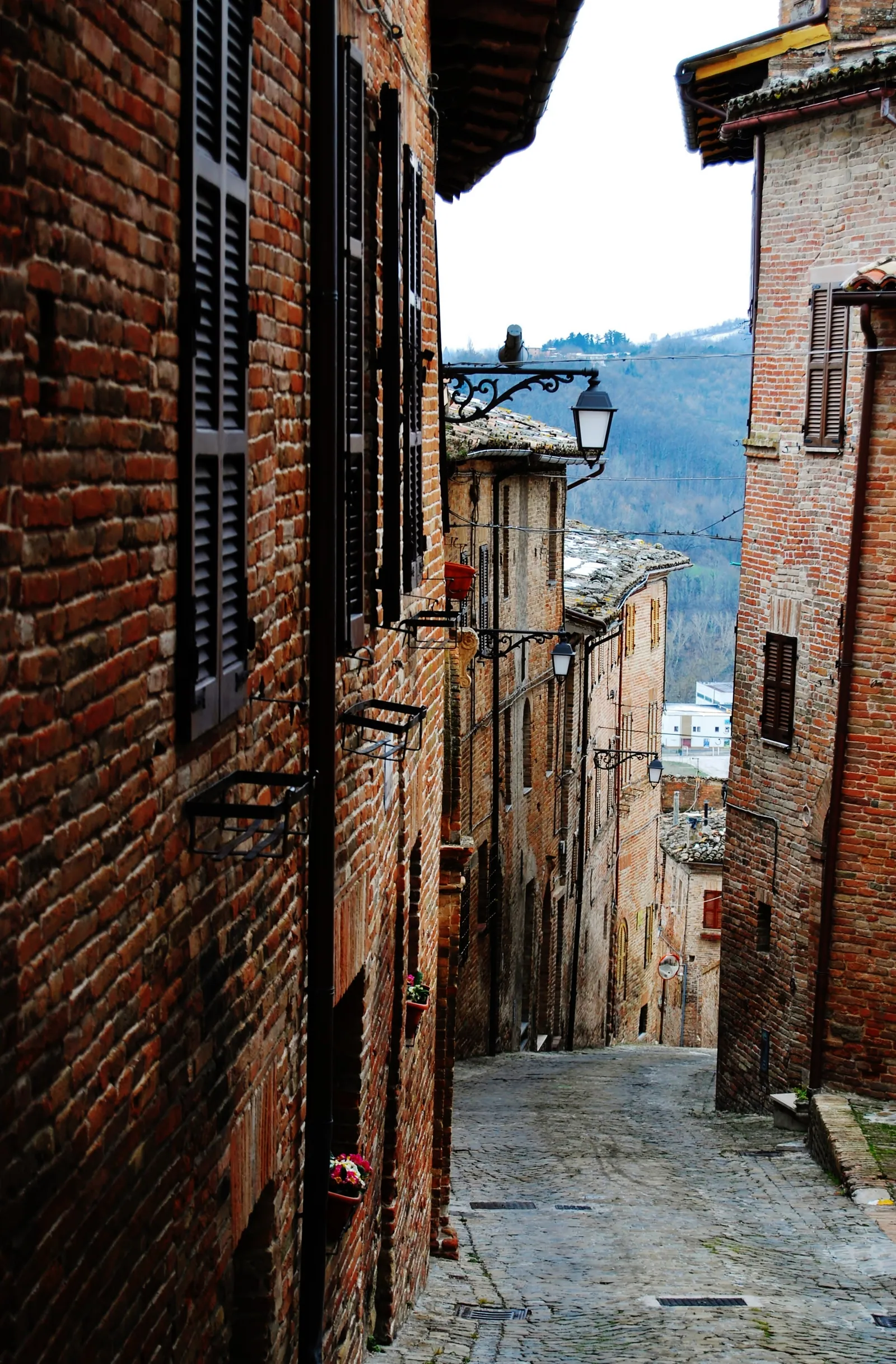
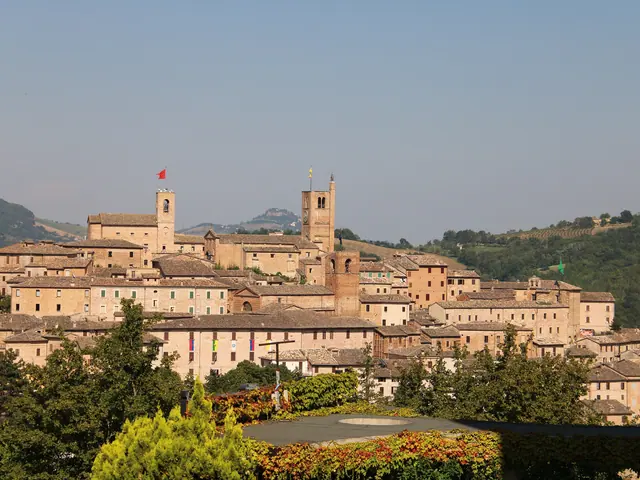
Sarnano is a medieval village in the province of Macerata, in the Marche region. It sits on a hill at 539 meters above sea level at the foot of the Sibillini Mountains, on a narrow tongue of land between the Tennacola stream and its tributary, the Rio Terro. The historic center dates from the 13th century, is built entirely of red brick and still keeps the shape of a castrum, a fortified village: the streets descend in concentric rings from Piazza Alta to the base of the hill. Sarnano is one of the Borghi più belli d'Italia (Most Beautiful Villages in Italy) and holds the Orange Flag (Bandiera Arancione) of the Touring Club Italiano. Its history as a free commune began in the 13th century: in 1282 an arbitration entrusted to two abbots forced the lords of Brunforte to recognize the commune of Sarnano.
Behind the town rise the last northern peaks of the range. Among them are Monte Castel Manardo, the highest point in the municipality, Monte Valvasseto, Monte Sassotetto and Pizzo di Meta. In winter there is skiing in the Sassotetto and Santa Maria Maddalena ski area. In the other seasons there are trails, waterfalls along the Tennacola and the waters of the San Giacomo spring, whose healing properties were discovered in 1929. The 2016 earthquake left visible marks: some buildings are still closed or being rebuilt, but the historic center can be explored on foot.
At a glance
- Municipality
- Sarnano
- Province
- Macerata
- Region
- Le Marche
On the map
Points from the site database. Map © OpenStreetMap contributors · Protomaps.
What to see in Sarnano
In Sarnano the main sight is the medieval historic center, with Piazza Alta at the top of the hill. A couple of hours is enough for the walk. Entering through Porta Brunforte, named after an old noble family of Ghibelline tradition, leads to Piazza Perfetti. From here the route climbs through alleys and stairways. On Via Mazzini is the church of the Annunziata, now deconsecrated. Via della Costa once separated the outside from the inside of the town: the Costa Bassa keeps its original steps, while the Costa Alta climbs from the little church of Santa Chiara up to Piazza Alta. On the way up you also pass under the Arco dell'Assassino (Assassin's Arch).
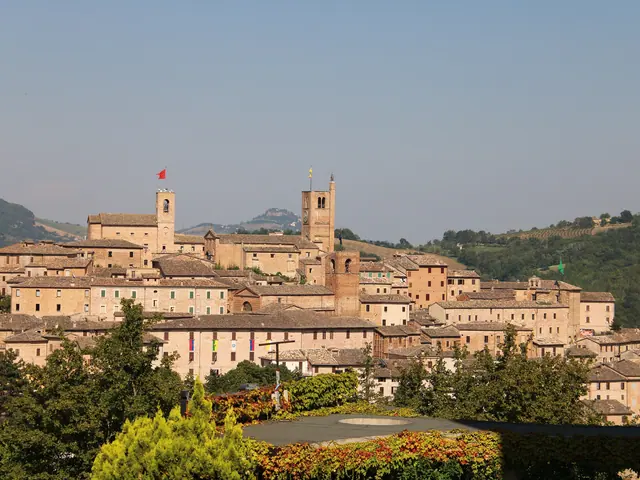
Piazza Alta, the highest point of the historic center, is overlooked by the Palazzo dei Priori, the Palazzo del Podestà, the Palazzo del Popolo (home of the Teatro della Vittoria) and the Collegiate Church of Santa Maria Assunta, also called Santa Maria di Piazza Alta. It is a Romanesque brick church, begun in the 13th century and completed in 1396. The bell tower, next to the apse, is from the 14th century. Above the stone portal of the facade, the lunette has a bas-relief of the Assumption. The church held works by Lorenzo d'Alessandro, Pietro Alemanno and Niccolò Alunno. After the 2016 and 2017 earthquakes the building was declared unsafe and firefighters moved the artworks to safety. The collegiate church is still partly closed today.
The Palazzo del Popolo with the Vittoria Theater, the Pinacoteca (art gallery), the Musei civici (civic museums) and the Abbey of Piobbico were also made unsafe by the 2016 tremors; the abbey reopened to the public in July 2024. Before planning a visit to the interiors, it is best to check whether they have reopened. Things are moving, though. The church of Santa Chiara, restored after earthquake damage, was inaugurated on March 28, 2026. In January 2025, 15 works moved after the earthquake returned to a new, restored museum space, pending the layout of the new Pinacoteca. The historic center also has the Church of San Francesco in Sarnano, near the Palazzo Comunale (town hall).
Outside the town, along the Terro valley, traces remain of the Eremo di Soffiano (Soffiano hermitage). Here in 1101 the local lords donated land to build a church, and a hermit's retreat was carved into a recess in the rock face. In the hamlet of Terro an oval stone marker was found, probably a pagan altar, known as the Pietra di Terro or Uovo di Sarnano (Egg of Sarnano).
In August the Palio del Serafino is held. It takes its name from the six-winged angel on the town's coat of arms, designed according to tradition by Saint Francis. Itineraries and monuments are described in detail on the page things to do in Sarnano.
Nature and trails near Sarnano
The easiest and best-known hike in Sarnano is the Via delle Cascate Perdute (Way of the Lost Waterfalls). It is a loop of about 6 km that starts from the historic center and takes in three falls of the Tennacola stream: the Cascata dell'Antico Mulino, the Cascata "de lu Vagnatò" and the Cascatelle di Sarnano. The route opened in 2020. Two of the waterfalls remained hidden by vegetation until that year. The difficulty is tourist level, the elevation gain is about 80 meters and it takes about 2 hours of walking. The only demanding section is a steep descent, to be climbed back up on the return, just before the Cascata dell'Antico Mulino. The route is waymarked throughout and can be walked in every season.
For the Via delle Cascate Perdute, hiking shoes are advisable, because the ground near the Cascatelle is slippery. Bring water: there are no refill points along the trail. The three waterfalls can also be reached one at a time.
From the Cascatelle a second loop of about 5 km, opened in summer 2021, leads to the Pozze dell'Acquasanta pools and the Cascate del Pellegrino. This section is more demanding: the elevation gain increases and the final part is a steep descent where a rope helps. Along the route you also walk a stretch of the Cammino francescano della Marca (a Franciscan pilgrimage route).
Higher up, the landscape becomes true mountain country. The Tennacola carves the Gola dei Tre Salti gorge between Castel Manardo and Monte Valvasseto. The Terro forms the Valle Jana between Pizzo di Meta and Punta del Ragnòlo. Above these walls stretch the uplands of the Piani di Ragnòlo, on the border with Fiastra and Bolognola.
In winter the reference is the Sassotetto and Santa Maria Maddalena ski area, about 12 km from the town. It has more than 11 km of slopes, mostly of medium difficulty, between about 1,300 and 1,680 meters, with artificial snowmaking on part of the runs and a floodlit slope for night skiing. On the Piani di Ragnòlo and in the Sassotetto and Maddalena area, cross-country skiing in the Sibillini, ski touring and snowshoeing are also popular. Information on the resort is on the page Sassotetto.
Where to stay in Sarnano
Those staying several days can sleep in Sarnano and use it as a base for the village, the trails and, in winter, the Sassotetto lifts, about 12 km away. The full list of accommodation is on the page where to stay in Sarnano.
Where to eat in Sarnano
In Sarnano the cooking is based on the traditions of mountain folk and farming families. Local dishes, sometimes reinterpreted, often appear on the town's menus. During "Sarnano in botte", the festival of wine and local products organized by the Pro Sarnano with the town council, dishes such as polentone bianco and coniglio in porchetta (rabbit stuffed and roasted porchetta-style) are served, and restaurants offer themed menus. Restaurants and trattorias are listed on the page on Sarnano restaurants.
Sarnano local products
The most representative product of Sarnano is ciauscolo, the soft cured salami considered the king of local specialties. It is made with pork belly, shoulder and trimmings of ham and loin, finely ground and seasoned with salt, black pepper and crushed garlic, then cured for at least 15 days. Traditionally it is eaten on unsalted bread, with pecorino or ricotta.
Among first courses, polentone stands out: a firm polenta cut into thin layers and baked with fatty and lean meat, pecorino or tomato sauce. Then there are vincisgrassi, the lasagna of the Macerata area, and tagliatelle or pappardelle with mushrooms and truffles, or with wild boar, hare or duck sauce. Among main courses and sides: lamb offal (coratella), hunter-style rabbit with garden herbs, beans with pork rind, and sautéed greens (erbe strascinate).
Sarnano's specialty is the crostata al torrone, a nougat tart. It is made by hand with almonds, hazelnuts and spices and baked in a wood-fired oven, which gives it its crunch. It goes well with a glass of aged vino cotto ("cooked wine"). At Easter, unglazed ciambelle (ring cakes) are made, to be eaten with cured meats. The water from the San Giacomo spring has also been sold commercially since its properties were discovered in 1929. Shops are listed on the page on Sarnano local products.
Sarnano weather and how to get to Sarnano
Sarnano can be visited all year round, but the climate changes a lot with the seasons. The climate is sub-Apennine, with more than 1,000 mm of rain a year. In winter, when cold air arrives from the northeast, the Sibillini behind the town encourage the stau effect, which brings heavy snowfall. Summer is hot and dry, but heat thunderstorms are frequent. Before a high-altitude hike it is always best to check the forecast.
By car, from both north and south, take the A14 highway to the Civitanova Marche exit. Then follow the Civitanova Marche–Foligno expressway (SS 77) to the Macerata Ovest/Sforzacosta exit and continue on state road 78 toward Sarnano. From Rome, take the A1 to the Orte exit, toward Terni and Foligno, then the expressway toward Macerata to the Caldarola exit, and from there follow the signs for Sarnano. From the town, provincial road 120 climbs to the Sassotetto lifts.
Without a car, the nearest train station is Tolentino, about 26 km away, connected to Sarnano by regular bus service. The reference airport is Ancona-Falconara: from there take the A14 toward Pescara and follow the same route.
In this section
5 results
 Things to Do in Sarnano13 places
 Where to Stay in Sarnano15 places to stay
 Sarnano Restaurants20 places
 Sarnano Local Products and Shops8 places
- Sassotetto (Sarnano)Le Marche · Macerata
No results with these filters.