


Small Temple of Sant'Emidio alle Grotte (Ascoli Piceno)
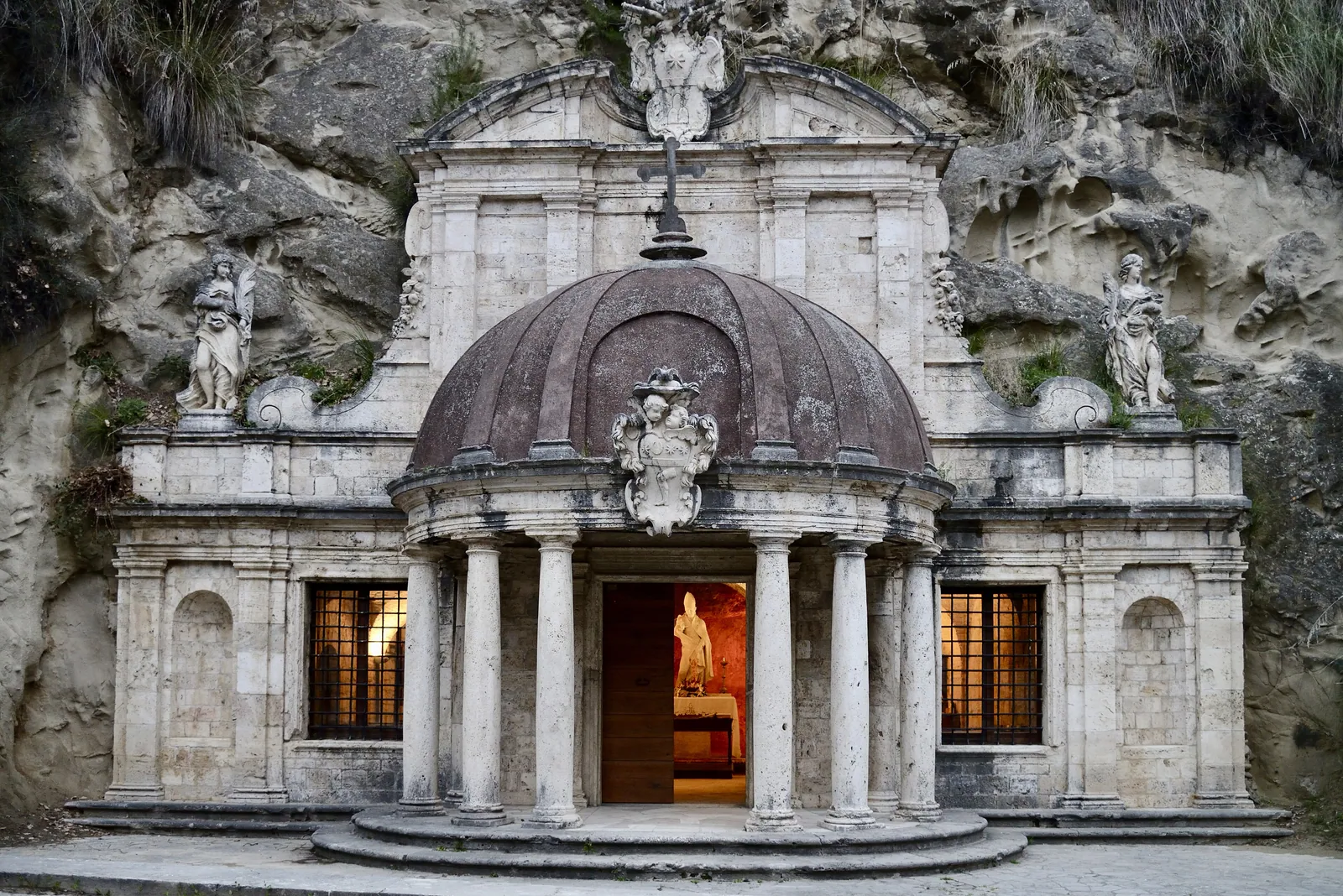
Small Temple of Sant'Emidio alle Grotte (Ascoli Piceno)
- Type
- Church
- Address
- Via CarsoAscoli Piceno (AP)
- s.emidiomondo.info@gmail.com
- Website
- santemidionelmondo.com
Source: site database, © OpenStreetMap contributors (ODbL).
The Small Temple of Sant'Emidio alle Grotte (Tempietto di Sant'Emidio alle Grotte), in Ascoli Piceno, is a Baroque church built from 1717 onward to a design by Giuseppe Giosafatti. Its interior is carved out of natural caves and niches. The travertine facade leans against the tufa wall of a hill in the northern part of the city. The tempietto is part of the Emidian itinerary, which links the places associated with the patron saint.
On the map
Points from the site database. Map © OpenStreetMap contributors · Protomaps.
History of the Small Temple of Sant'Emidio alle Grotte
The caves were already known in the year 250, connected by tunnels and used by Christians as a necropolis. According to tradition, Emidio was beheaded on August 5, 303 near the bridge of Porta Solestà. From there he is said to have walked all the way here, holding his head in his hands, to be buried. The caves were later turned into an oratory.
The present building is an ex-voto offered by the people of Ascoli for the strong earthquakes of 1703, which caused no victims or serious damage in the city. The first stone was blessed on April 4, 1717 by Bishop Giovanni Gambi, a relative of Pope Clement XI. The works lasted until 1720-21 and were entrusted to Giosafatti, who drew on Pietro da Cortona and on his master Gian Lorenzo Bernini. This is considered his most Berninian work.
Over the centuries the church also went through periods of neglect. Restorations, including the one in 1954, mainly concerned the interior, affected by water seepage and damp. In 2000 the tempietto was included among the "Luoghi dello Spirito" (Places of the Spirit) of the Jubilee routes in the Marche.
What to see in the Small Temple of Sant'Emidio alle Grotte
The travertine facade has two superimposed levels. The lower level, in the Doric order, has at its center a small elliptical dome supported by six columns, with the coat of arms of Bishop Gambi. On the upper level, a circular pediment holds the arms of Clement XI. At the ends, two larger-than-life angels hold a palm branch, a symbol of martyrdom.
Inside, the central cave is divided by pillars into three small aisles with brick cross vaults. At the back the space has been left intact, to show the burial niches and graves where Emidio and his disciples were laid to rest. Behind the single altar is the travertine statue of Sant'Emidio, carved and signed by Giosafatti. In 1943 a tunnel was also opened leading to a cave with a small cemetery and an arcosolium.
How to visit the Small Temple of Sant'Emidio alle Grotte
Visits are by appointment, to be arranged reasonably in advance. To enter, ring the bell of the office opposite the tempietto and a guide accompanies visitors inside. Up-to-date contact details are in the box on this page.
During the patron saint's feast on August 5, celebrations may take place on site.
Where the Small Temple of Sant'Emidio alle Grotte is
The tempietto stands in Ascoli Piceno, just outside the center, in the northern area, at the foot of the campo Parignano hill. It is opposite the former church of Sant'Ilario.
Around the Small Temple of Sant'Emidio alle Grotte
The Small Temple of Sant'Emidio Rosso is an octagonal 17th-century building, erected where the saint was beheaded. The stone of the beheading is still kept under the altar. The remains of Emidio were later moved to the crypt of the Cathedral of Sant'Emidio in Ascoli Piceno. For other stops in the city, the list is on the page about things to do in Ascoli Piceno.
Frequently asked questions
Can you visit the tempietto without booking?
Why is the tempietto called "alle Grotte" (at the caves)?
Who designed the tempietto and when was it built?
Where were the remains of Sant'Emidio originally kept?
Nearby
What to see nearby
- Church of Sacro CuoreChurch200 m
- Statue of Christ the Redeemer (Ascoli Piceno)Monument or memorial200 m
- 500 m
Where to stay
- A Due Passi dal Centro, Ascoli PicenoGuesthouse300 m
- 400 m
- 500 m
Where to eat
- Macelleria Clerici, Ascoli PicenoButcher and pork products400 m
- Pizza Pazza 2, Ascoli PicenoFast food and street food400 m
- Macelleria Benigni, Ascoli PicenoButcher and pork products400 m
Straight-line distances.