


Foce di Montemonaco: what to see, trails and travel tips
At a glance
- Municipality
- Montemonaco
- Province
- Ascoli Piceno
- Region
- Le Marche
Foce di Montemonaco is the last village in the Aso valley before the dead-end valley of Lago di Pilato. It is a hamlet of the municipality of Montemonaco, in the province of Ascoli Piceno, at about 945 meters above sea level, inside the Sibillini Mountains National Park and near the border between the Marche and Umbria. Its few houses follow the floor of a valley shaped by ancient, intense glacial action, which to the south joins the Valle del Lago di Pilato. The Sibillini range rises all around. The paved road ends here, at about 950 meters, in front of a small square with the mountain hut and the church. Fewer than twenty people live in the village, but the square is often crowded, because the classic trail to Lago di Pilato starts from Foce.
The history of Foce di Montemonaco is old. The church of San Bartolomeo already appears in April 1178 in donation documents of the Monastery of Fonte Avellana. In 1420 the French writer Antoine de La Sale passed through and drew a large Gothic church that no longer exists. Among peaks, gorges, waterfalls, meadows and woods, many legends were born, such as the one about the fairies who come down from the mountains to dance the saltarello with the young people of the village.
On the map
Points from the site database. Map © OpenStreetMap contributors · Protomaps.
What to see in Foce
Foce has three places to visit: the small square with the monument to Don Basilio Brunori, the church of San Bartolomeo and the traces of water, that is, the small lake and the spring of the Aso river.
In the middle of the square in Foce stands a pyramid-shaped concrete monument, about five and a half meters high. It is dedicated to Don Basilio Brunori, parish priest of Foce from August 1912 to December 1914, who died in the war on August 26, 1917. The monument was inaugurated on the second anniversary of his death. On the front there is a plaque with an inscription in his honor. On the other two sides, two marble slabs record the citations for the two silver medals for military valor that the priest received in the war.
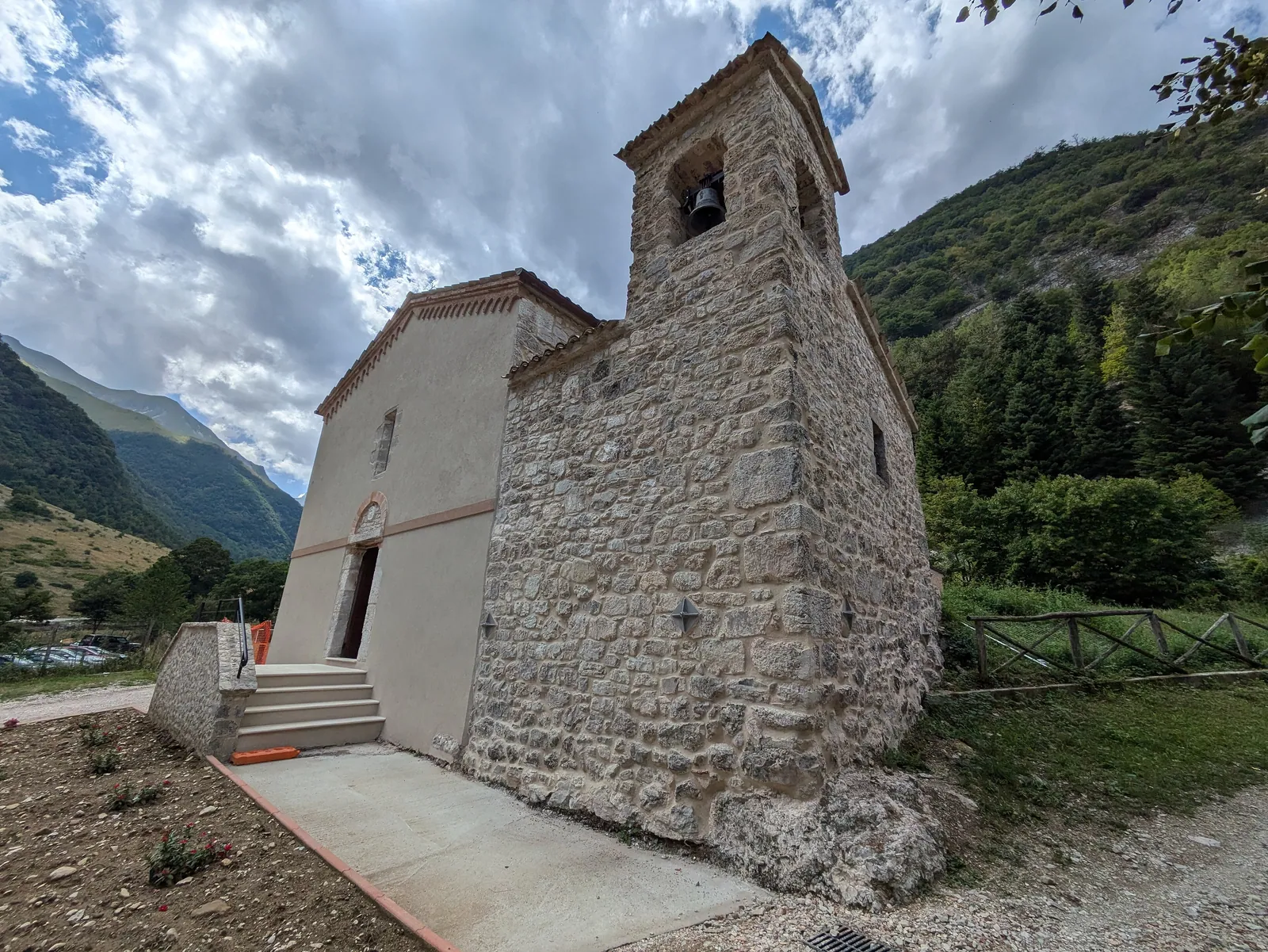
The church in Foce is dedicated to Saint Bartholomew the Apostle, patron saint of the village. It is built of stone and partly plastered, perhaps on the ruins of a hermitage or an abbey. Don Brunori himself believed so, and in 1913-14 he had the interior and exterior restored. On that occasion a side entrance on the south facade was closed and the current main entrance was opened on the east side, reached by two side staircases. In 2026 the church is in order, but it is still waiting for the return of the statue of San Bartolomeo, removed after the 2016 earthquake.
Of another church, only the memory remains. Antoine de La Sale visited it in 1420 and called it «Sainte Marie de Fogia». He described it in the book Le paradis de la Reine Sibylle and drew it in the Carte de l'édition gothique, kept in the National Library in Paris. In the drawing it is a Gothic church with a small rose window, mullioned windows, a gabled roof and two pointed bell towers. The size of the drawing suggests an important building. Nothing of it survives today.
Water has always been at the heart of Foce. The village had a small natural lake, the "laghetto", fed until the 1990s by water from Lago di Pilato that resurfaced here. Trout and freshwater shrimp lived in it. Then the groundwater of the Foce mountains was tapped for the water needs of the Marche, with boreholes hundreds of meters deep into the mountain. The water table dropped, the spring of the Aso moved two kilometers further downstream and the small lake dried up.
The Aso river rises near Monte Vettore, between Monte Porche (2,233 m) and Cima della Prata (1,850 m). Its waters first appear on the surface in Lago di Pilato. After about six kilometers underground, the river resurfaces just before Foce and then flows to the Adriatic Sea at Pedaso.
Foce is also a place of legends. It is said that the fairies, fleeing toward Monte Vettore before dawn on their goat feet, traced a small path that can still be seen, the "sentiero delle fate" (fairies' path). Other folk tales speak of rugged places in the area: the Gola dell'Infernaccio, the Pizzo del Diavolo, Passo Cattivo, the Grotta del Diavolo and the Valle Scura. To round off the visit, the page on things to do in Montemonaco describes the main village.
Nature and trails near Foce
Foce di Montemonaco is the starting point of many mountain routes. There are easy walks in the woods and true mountain itineraries, including some for experienced hikers. The main destinations are Lago di Pilato, Monte Argentella (2,200 m), Palazzo Borghese (2,145 m), Monte Sibilla (2,173 m), Monte Porche (2,233 m) and the Grotta delle Fate.
The best-known hike goes from the village to Lago di Pilato, at 1,941 meters below Monte Vettore. Here are the key facts:
- Trail marker: 151.
- Elevation gain: between about 940 and 1,000 meters.
- Difficulty: E (hiking grade).
- Duration: about 5-6 hours round trip.
- Best period: from May to October.
The route starts from the small bridge in the village and follows the dirt road along the Piano della Gardosa. It then climbs through the beech wood to the hardest stretch, the "Svolte": a steep rocky gully below a vertical rock face. Above, at around 1,450 meters, the valley opens up and the climb to the lake becomes easier. The Svolte were reopened by an ordinance of the Municipality of Montemonaco of May 30, 2018. The Park regards the three routes linking Foce to Lago di Pilato (132, 151 and 152) as "historic trails", but does not manage them directly.
The lake is home to the Chirocephalus marchesonii, a small endemic crustacean. To protect it, the Park regulations forbid entering the water, leaving the trail on the scree slopes and, when the lake is dry, walking on its bed. In winter the valley is very dangerous because of avalanches.
For an easier route, the comfortable path across the Piano della Gardosa reaches about 1,140 meters without tackling the Svolte. Before the Svolte, on the plateau, a fountain sprays water upward like a geyser and draws many visitors in winter.
The other routes are more demanding:
- Trail 132 starts a little below the small lake. It climbs steeply through the beech wood, passes Fonte Fredda (1,748 m) and reaches a saddle at 1,823 meters. From there the long traverse continues over Monte Vettore and down to Forca di Presta, with over 1,500 meters of ascent.
- Trail 154 starts from a parking lot just before the village and climbs the Zappacenere gully. It leads toward Palazzo Borghese and Monte Porche.
The landscape changes as you climb. The wood of downy oak, hop hornbeam and manna ash gives way to beech forest. On the peaks of Monte Vettore the rare Apennine edelweiss still grows. In the 1970s the wildlife had become impoverished; then the Apennine wolf, roe deer, red deer, wildcat and Apennine chamois were reintroduced. The golden eagle has returned to nest in areas long abandoned. Guides and guided hikes are listed on the page Montemonaco activities and guides.
Where to stay in Foce
There are very few beds in Foce. On the square there is a mountain hut with a restaurant that also offers rooms. It is a convenient base for an early start toward Lago di Pilato or the ridges. For other options, look to the main village and the other hamlets: the full list is on the page where to stay in Montemonaco.
Where to eat in Foce
In Foce, meals are served at the mountain hut on the square, which offers the traditional mountain cooking of the Marche: cured meats, soups, game, polenta, tagliatelle, and grilled lamb and mutton. Other restaurants in the area are on the page Montemonaco restaurants.
Local products of Foce
Foce shares the local products of the municipality of Montemonaco. The best known are the marroni (large chestnuts) from the centuries-old chestnut groves. The Sagra Mercato della Castagna, a chestnut fair, is held in Montemonaco every year on the last weekend of October. Besides fresh chestnuts, local producers bring truffles, potatoes, honey, walnuts, hazelnuts and apples.
Montemonaco is also one of the best-known areas for Pecorino dei Sibillini, a raw-milk, semi-cooked, aged sheep's cheese protected by a Slow Food Presidium. The surrounding mountains are rich in medicinal plants. In past centuries elderly women gathered them to make decoctions, infusions and ointments of folk medicine.
Weather and how to get to Foce
Foce di Montemonaco has a continental climate, with wide temperature swings. Summers are cool and winters very harsh: on the highest peaks temperatures drop to -25 °C. In winter, snow and falling rocks can make the road up the gorge difficult. Before setting off, it is wise to check the weather and road conditions.
From Ascoli Piceno, take the SS4 Salaria to Mozzano. Right after, turn onto the SP237 toward Comunanza, passing Roccafluvione and Croce di Casale. Then take the SP86, which runs along Lago di Gerosa. At Pignotti, turn toward Foce, about 5 km away. The total is about 40 km. From the A14 highway, exit at San Benedetto del Tronto and follow the link road to Ascoli. From Macerata, the route goes through Sarnano, Amandola and Montefortino to Montemonaco, where a sign points to Foce.
The last stretch goes through the hamlet of Rocca and then the Aso gorge, with the road on the valley floor beside the river. Shortly after Rocca, a tunnel passes under the large landslide caused by the 2016 earthquake, which had cut Foce off for a long time. There is a traffic light before the tunnel. To visit the main village, the page on Montemonaco gathers its history and places of interest.