


Castelluccio flowering: when the lentils bloom
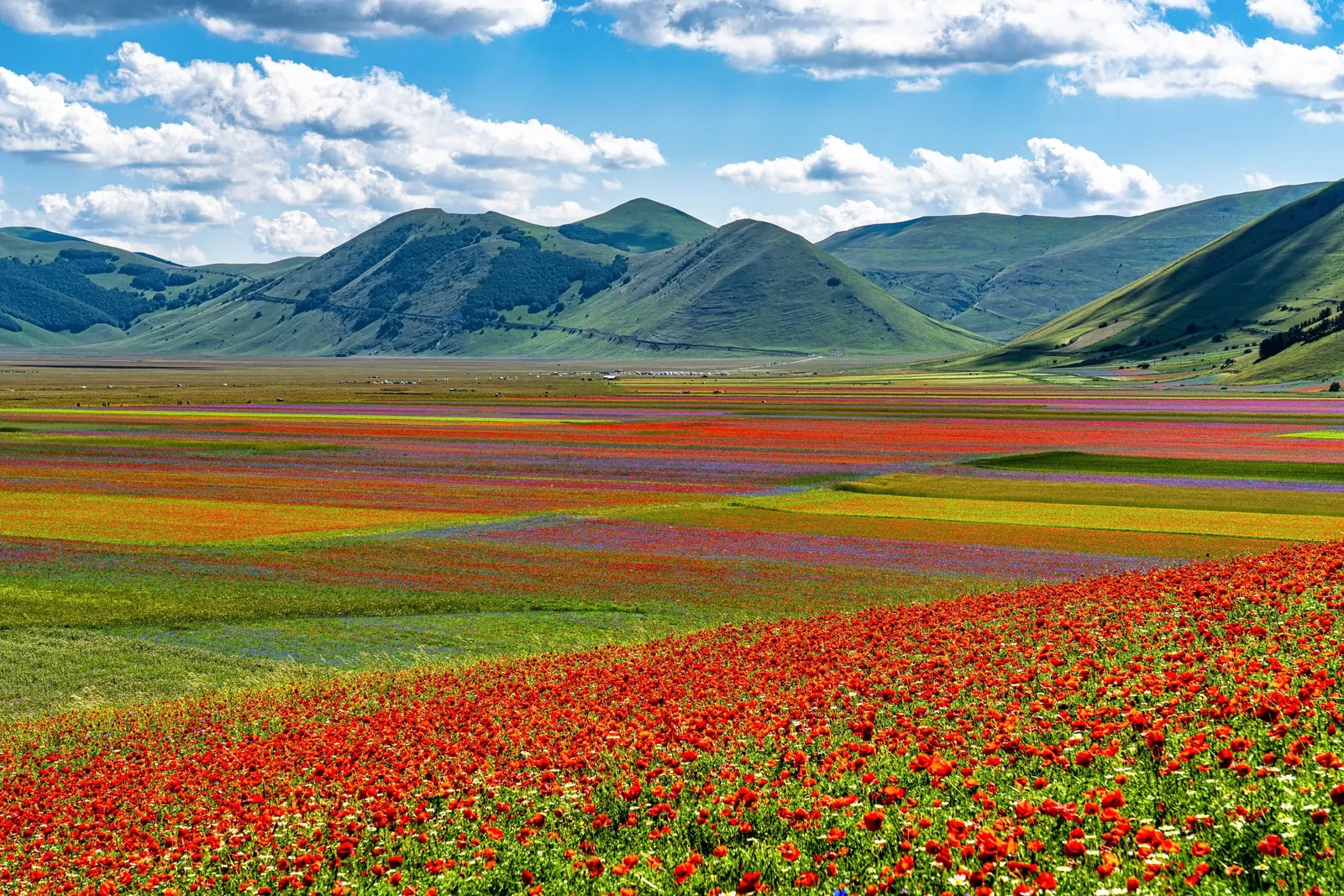
The Castelluccio flowering, known in Italian as the fiorita, is the bloom that every year, in a period running from late May to mid-July, colors the plains of Castelluccio di Norcia, in the national park of the Sibillini Mountains. It is not a single event: the Pian Grande changes color from week to week, sometimes from day to day. The colors are usually most intense between the second half of June and the first half of July. They come not only from the lentil plants but also from Sibillini Mountains wildflowers that grow spontaneously among the crops, such as poppies, cornflowers and mustard. These plants thrive because no pesticides are used in the fields where the Castelluccio lentil is grown.
From above, the plain can be seen from the village of Castelluccio, at 1,452 meters, one of the highest villages in the Apennines. On the slopes of Poggio di Croce is also the famous Italy-shaped forest of the Sibillini, planted in 1961 when, during the Festa della Montagna, the outline of the peninsula was drawn with conifers. Visitors to Castelluccio today also see the effects of the earthquake. The village was almost entirely destroyed by the 2016 tremors. Reconstruction work began in May 2024: the whole village will be seismically isolated on slabs fitted with 300 seismic isolators. Reconstruction is still under way and the area can be visited on a walk around its perimeter.
Castelluccio flowering: what to know
The Castelluccio flowering takes place on the karst plateau below the village of Castelluccio, a hamlet of the municipality of Norcia, in the province of Perugia, about 28 km from Norcia, roughly 40 minutes by road. The Piana di Castelluccio covers about 15 km² and is made up of the Pian Grande, the Pian Piccolo and the Pian Perduto. The meadows and fields that take on the most color are those of the Pian Grande and the Pian Perduto, with wildflowers and lentil fields. In the background rises Monte Vettore, 2,476 m. The Pian Grande is also known for a sinkhole, the Fosso dei Mergani.
At the heart of the flowering is the Castelluccio lentil IGP (Protected Geographical Indication), called “lénta” by locals. Its history is very old: seeds have been found in tombs dated to 3000 BC. It is an annual plant sown after the snow cover melts. In the past the harvest, the “carpitura,” was done mainly by hand by women, the carpirine. Lentil flowers are small and easily overlooked: they have white corollas spotted with purple.
Many other species, typical Monti Sibillini wildflowers, grow around the lentils. On the Pian Grande and the Pian Perduto, along the paths, you can find gentians, daffodils, violets, poppies, buttercups, asphodels, Viola eugeniae, clovers, wood sorrel, as well as daisies and Venus's looking-glass. The cornflower is precious because it is rarely seen in its natural habitat, the grain field, since it is considered a weed and pulled up. At Castelluccio, instead, it grows among the lentils. The poppy is a pioneer plant and can produce more than 400 flowers in a single season.
Animals also live on the plateau: during the flowering it is possible to spot roe deer, the golden eagle or the peregrine falcon. More about the park's species is on the pages Sibillini flora and fauna and Sibillini National Park wildlife.
Castelluccio flowering: when to go
There is no fixed date for the Castelluccio flowering. The timing depends on the climate, the course of the season, the amount of rain, and when the winter ends and how harsh it was. According to the Park, peak flowering usually falls in the last week of June, but it can come a few days earlier or later. The best moment often falls between late June and early July: the first week of July usually brings the peak of the cornflower bloom, mixed with the lentil flowers.
Each flower has its moment. This is the approximate calendar of when the Castelluccio flowers bloom:
- Second half of May: around May 20, on the Pian Grande, mountain tulips (Tulipa australis) bloom in the half-flooded meadows near the Fosso dei Mergani, together with yellow buttercups and white cornflowers. The yellow tulip is on the Umbria Region's list of species at risk of extinction.
- From mid-May: the first red poppies appear, reaching full bloom in late June.
- From mid-June: the yellow increases with wild mustard, which has clustered yellow flowers with four petals and a pleasant scent.
- From May to July: the lentils flower. In June the lentil is already in full bloom with its small white flowers.
- Late June and early July: the blue of the cornflower arrives, the last to open because it needs more light than the other flowers.
August is the least suitable month for a visit, because there are few flowers and the lentil harvest begins.
The day of the week matters too. Traffic is heaviest toward the end of the flowering, when the display peaks with the arrival of the blue, and long lines then form to reach the Pian Grande, from both Norcia and Visso. A weekday is therefore the better choice: on weekends the crowds are very large. Before leaving, it helps to ask in Norcia how the flowering is progressing that week.
Castelluccio flowering: practical tips
Castelluccio can be reached by car from three directions: from Norcia, from Castelsantangelo sul Nera and from Arquata del Tronto, via Forca di Presta. During the busiest periods the Sibillini National Park and the municipalities apply a Sustainable Mobility Plan. On regulated days, access to the plateau by car and camper van is banned, and visitors use the parking lots along the access roads, continuing by shuttle. In 2026 the ban applied on June 20-21, on the weekends of June 27-28, July 4-5 and July 11-12, and on Monday, June 29. The dates change every year and should be checked before setting out.
In recent years the shuttle parking lots have been Monte Prata and Forca di Presta on the Marche side and Scentinelle on the Umbrian side. The shuttles are mandatory, and both the parking space and the ride must be booked online. Last-minute tickets can also be bought on site, while availability lasts. After leaving the car, visitors can also go up on foot, by bicycle or by e-bike.
Some vehicles may pass even on restricted days: two-wheelers and the cars of residents, people staying there, business operators, people with reduced mobility or those authorized by the municipalities. Tour buses may drop passengers near the Deltaplano and the Piazzetta. Those who only need to cross the area may do so, but without stopping or parking. On other days car access is open, but parking on the meadows and along the roadside remains forbidden.
On site there are three rules to follow: do not enter the fields, because they are cultivated; do not pick the flowers; do not park on the meadows. Trampling the fields damages the IGP lentil crops and the ecosystem.
There are several viewpoints for seeing the flowering from above. The Pian Grande can be viewed from the village of Castelluccio. Also panoramic are some stretches of the road climbing to Forca Canapine or the one leading to Arquata del Tronto, and the dirt track toward Poggio di Croce, the mountain that overlooks Castelluccio and its plain. For a hike, follow the Grande Anello dei Sibillini along the ridge west of the Pian Grande. The trail starts from the Monte Cappelletta pass at 1,520 m and climbs to the Monte Ventosola pass (1,620 m). It then reaches about 1,750 m along the ridge and descends on a gravel road to Castelluccio.
To avoid the crowds, arrive early in the morning or in the late afternoon. At this elevation it is cooler than in the valley, so a light jacket is useful. Anyone wanting to stay overnight in Castelluccio should book early, because only a few places to stay have reopened since the earthquake.