


Fall foliage in the Sibillini, Le Marche
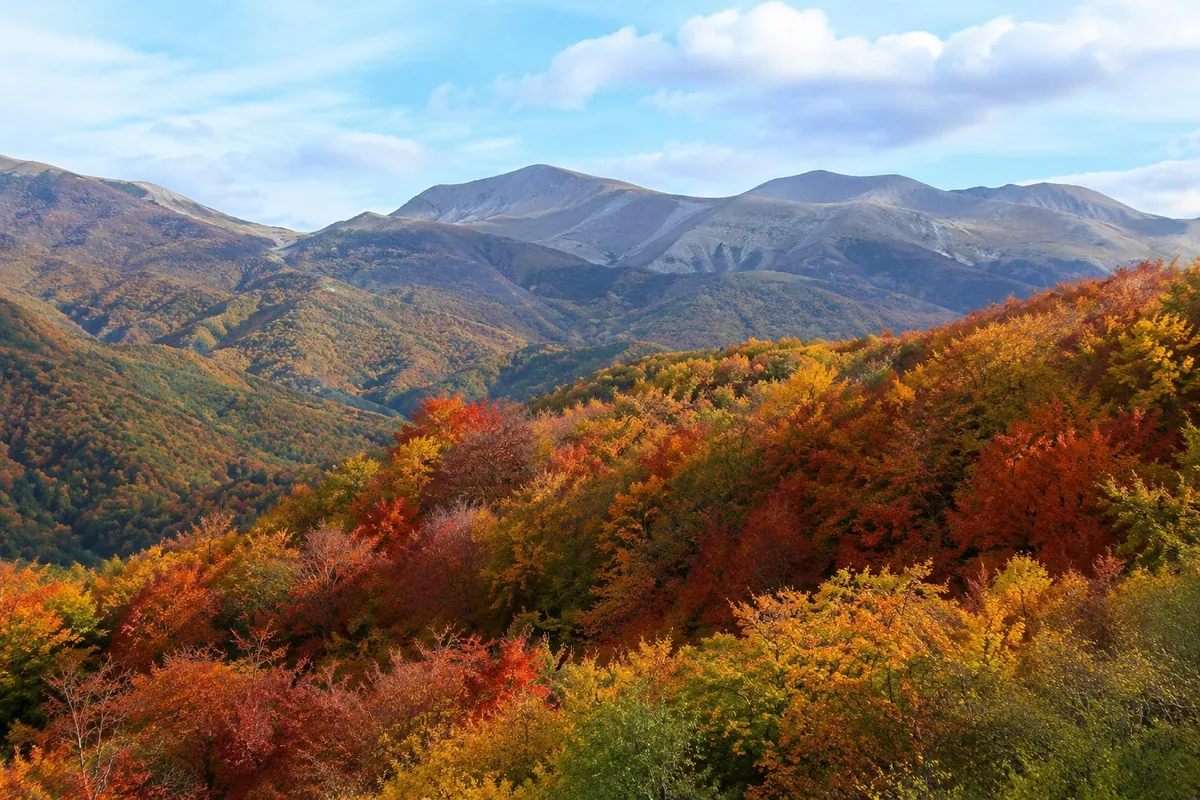
Fall foliage in Le Marche finds its most varied setting in the Sibillini Mountains, and the Sibillini make a fine place to watch it. The national park stretches across Le Marche and Umbria and includes many mountains above 2,000 m. The vegetation changes with altitude. Up to about a thousand meters, downy oak, hop hornbeam and manna ash prevail; higher up, beech forests dominate. In fall this mosaic produces different colors from one valley to the next, from golden yellow to deep red.
The season runs from October to the first days of November: the best time is between late October and early November, when the colors reach the lower elevations. The most visited spots on the Marche side are the Gole dell'Infernaccio gorge at Montefortino, the beech forests of Ussita and Sassotetto, the area around Lago di Fiastra and the woods of Montemonaco.
Fall foliage in the Sibillini: what to know
Fall foliage in the Sibillini does not have a single look. Woods at middle elevations gradually begin to turn during October. The great beech forests become the main attraction for anyone who wants to walk among the leaves. Beeches turn a golden yellow fading to brown. Maples range from yellow to orange to red, ash takes on a purplish red and wild cherry a brighter red. Among the shrubs, the smoke tree turns red and orange. The larch, a species planted in the pine woods, turns a vivid yellow in November.
Gole dell'Infernaccio (Montefortino). The area lies in the territory of Montefortino, in an eastern part of the park where rock walls, streams and woods climb the valleys. The trail follows the Tenna river, still a small mountain stream on this stretch near its source, and climbs to the Hermitage of San Leonardo al Volubrio, a hermitage at 1,128 m. Around the hermitage there is a large beech forest and dense growth of yew and maple. The high walls of the gorge frame the colors. It is one of the easiest hikes for seeing the Sibillini foliage.
Ussita. In the Val di Panico, near the hamlets of Calcara and Casali, there are beeches, maples and hornbeams. In the Val di Bove, beeches and larches turn a very intense yellow. From Calcara you can leave the car and continue on foot along the dirt road to the Val di Panico.
Sassotetto and Fiastra. Sassotetto, at about 1,300 m, is known mainly in winter for its snow and ski lifts. In fall the large beech forest around it turns yellow. At Fiastra, in the locality of San Lorenzo al Lago, an equipped path runs along the lakeshore, suitable for a shorter walk. The Fiastrone valley, with the Lame Rosse, is recommended for autumn trekking; the Gole del Fiastrone trail, however, is closed by ordinance.
Montemonaco. The municipality is surrounded by the highest peaks in Le Marche. It is known for centuries-old chestnut trees and abundant mushrooms.
The Umbrian side, Macchia Cavaliera. In the Castelluccio sector, Macchia Cavaliera is a large beech forest covering the northwestern slope of Monte Macchialta. It is reached by routes starting from the Forca di Presta area. In fall a thin mist often rises from the Piano Grande of Castelluccio, known for its summer bloom, and is part of the landscape. For that season of colors, the article on the Castelluccio flowering tells the other side of the plateau.
Beyond the Sibillini. The best-known forest in Le Marche for fall foliage is the Faggeta di Canfaito, in the Monte San Vicino and Monte Canfaito Regional Nature Reserve, in the municipality of San Severino Marche. It is home to centuries-old beeches, including the oldest in Le Marche. The trails are easy and suitable for children too, and the colors are intense from mid-October to early November.
For a broader picture of the park's natural habitats, see the page on Sibillini flora and fauna.
Fall foliage in the Sibillini: when to go
The best time runs from late October to the first ten days of November. Generally the ideal window is from October 20 to November 10. October remains the reference month, however, because by mid-month the woods at middle elevations are in full change. In the areas around Norcia and Castelsantangelo sul Nera the display is especially intense between late October and early November.
It is not wise to fix on one precise week. Elevation and temperatures create clear differences even between two neighboring valleys: lower down the colors last longer, while in the high beech forests the change comes earlier. Those with fixed dates can plan several stops at different elevations. For example, they can visit a lower wood such as Montemonaco's and a beech forest such as Sassotetto or Ussita.
Fall has other advantages. Many trails can be walked in cooler temperatures than in summer and are often uncrowded. The days shorten quickly, though, so it is best to start early and plan to be back in daylight. In this season Montefortino is known for chestnuts, porcini mushrooms and white truffle. In fall Montemonaco and Montefortino hold food festivals and celebrations, which make it easy to combine a hike with a stop in the village.
Fall foliage in the Sibillini: practical tips
Gole dell'Infernaccio: how the walk works. The simplest route for autumn colors starts from the Valleria parking lot, above Rubbiano, a hamlet of Montefortino. Rubbiano can be reached by car from both Montefortino and Montemonaco. Past the village, follow a road to a pull-out a couple of kilometers on, where a barrier blocks vehicles. The pull-out is only for turning: park along the edge of the lane. On foot, continue about 700 m downhill to the entrance of the gorge. Nearby there is a small wooden hut that serves as an information point.
To the hermitage the route is about 7 km round trip, with about 300 m of elevation gain and a duration of 3 hours. One description gives the outward leg alone as 3.5 km and about an hour, with 386 m of ascent. The difficulty is easy hiking (T/E). Dogs on a leash are allowed. The route is not suitable for strollers and requires a basic level of fitness for mountain walking.
Current conditions. The Infernaccio trail was closed because of winter avalanches and reopened on July 17, 2026 (ordinance of the Municipality of Montefortino no. 32) as far as the second junction for the Eremo di San Leonardo, with a helmet mandatory. The trail toward Capotenna, the source of the Tenna, remains closed for safety reasons. The Eremo di San Leonardo was damaged by the 2016 earthquake: it can be seen from the outside, and from the square there is a view of the north face of Monte Sibilla. In August 2026 the drinking fountain near the hermitage was not working. Bring water from home and check trail conditions before setting out.
Gear. Hiking boots, not sneakers, are needed to avoid slipping on wet ground. Trekking poles are recommended. There are no places to eat or drink along the route. As for any mountain hike, it makes sense to check the weather before leaving.
With a guide. In fall the official Park Guides lead hikes in the Sibillini beech forests. Among the lesser-known spots is the beech forest of Monte Cavallo. Those who prefer a longer route can choose the GAS, the Grande Anello dei Sibillini, which crosses villages, forests and mountains. Higher up there are viewpoints such as Monte Vettore, the highest peak in the region.
Those who want to combine the colors with wildlife watching can see the page on Sibillini National Park wildlife.