


The Lago di Pilato legend
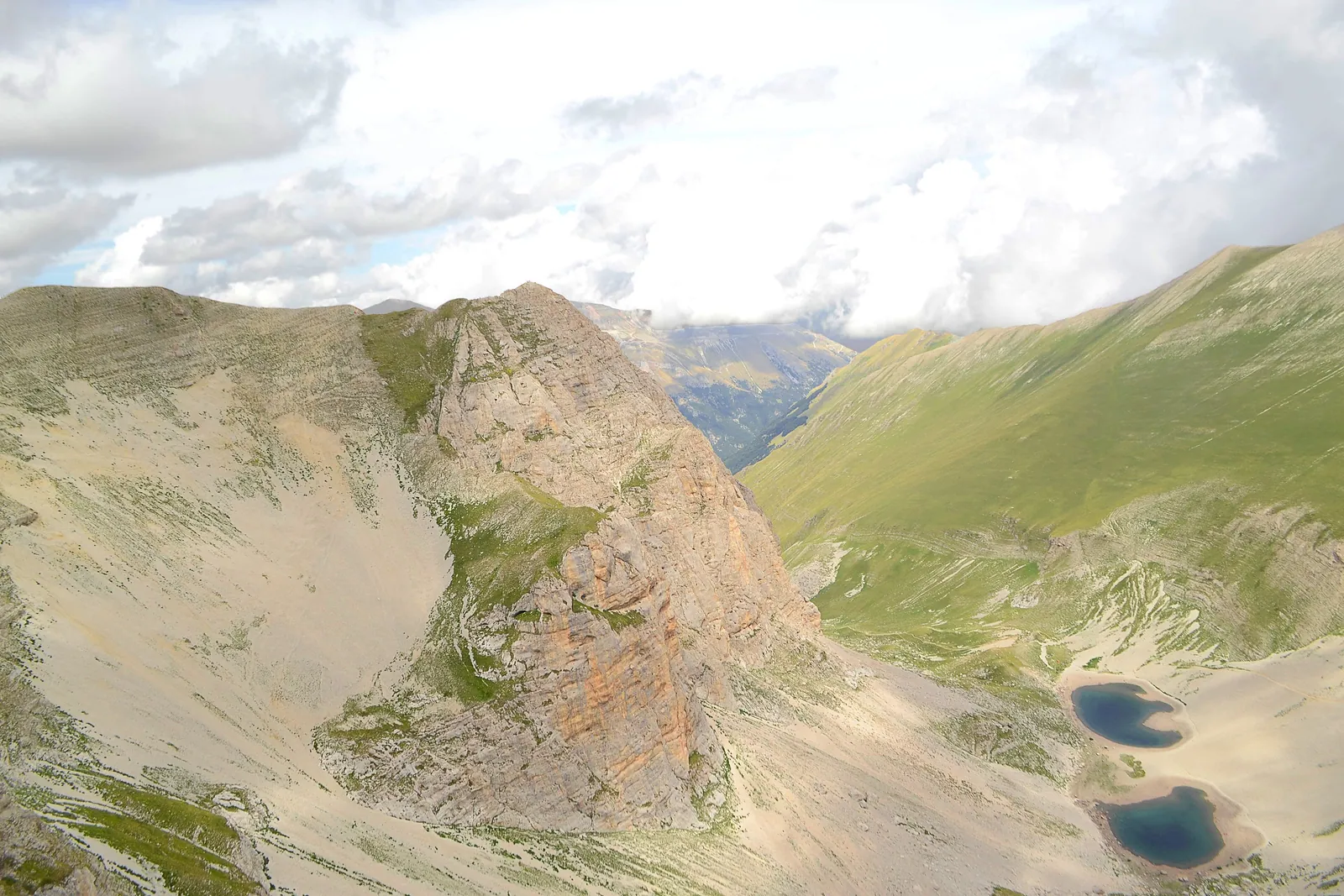
The Lago di Pilato legend links the name of Lago di Pilato (Lake Pilato) to Pontius Pilate, the Roman governor responsible for sentencing Jesus Christ to death. According to the folk tale, his body was loaded onto a cart pulled by two buffaloes. Setting off from Rome, the cart is said to have reached the Sibillini Mountains, where the animals threw themselves into the lake. The lake thus took Pilate's name.
The place really exists and is among the most unusual in the Apennines. The Lago di Pilato valley lies at 1,941 m, in the municipality of Montemonaco. The lake sits below the summit of Monte Vettore and is the only natural basin of glacial origin in Le Marche. Around it revolve tales of necromancers, of a gate to the Underworld and of a Sibyl who fled her cave. It can only be reached on foot, and anyone climbing up should know the rules that protect the area.
Lago di Pilato legend: what to know
The most widespread version is the one with the cart. Pilate is said to have asked to be buried in a remote, lonely place. His body, dragged by two maddened buffaloes, is said to have traveled thousands of kilometers to the slopes of the Sibillini. Some variants add details. The body was sewn into a sack and entrusted to the buffaloes, left free to wander aimlessly. The animals climbed up to Cima del Redentore, a peak from whose ridge the body fell into the water. More recent versions say the buffaloes threw themselves off that ridge and that the marks of the cart wheels can still be seen on the rock.
There is also another tradition, recorded at the end of the 19th century. Professor Vincenzo Ghinassi of Spoleto reported that by then the memory of Pilate's body had been lost. Instead, it was said that at the moment of the crucifixion the mountain people saw the Sibyl flee her cave and the water of the lake turn red, as if bloodied. From then on, a small plant grew on the shores with leaves like two hands joined back to back, in which people recognized the hands of Christ pierced by the nails. The mountain dwellers are said to have named the lake after Pilate because of these events. The figure of the Sibyl is covered in more depth on the page devoted to the Apennine Sibyl.
Then there is the lake's dark side. It was said that an entrance to the Underworld opened on its shores, reached by rugged passages. From the 13th century the place was considered to be haunted by witches and necromancers. The religious authorities forbade access and placed a gallows at the start of the valley. Dry-stone walls were also built around the water to keep people from reaching it. In ancient times the lake was called Lacum Sibillae. Other tales in the same vein are collected in the fairies and necromancers of Sibillini legend.
Travelers and writers also added to the allure of the place. Antoine de La Sale wrote "Il paradiso della Regina Sibilla" (The Paradise of Queen Sibyl), recounting his journey and his visit to the cave. The work, originally titled "Le Paradis de la reine Sibylle", describes a journey made in 1420. The page Antoine de La Sale and the Paradise of Queen Sibyl is devoted to him. Andrea da Barberino, with the "Guerin Meschino", brought another hero to the Sibillini, who came here to learn the fate of his parents. The character is presented on the page on the Guerin Meschino legend. A broader picture is in the section Legends of the Sibillini Mountains.
A curiosity about how far these tales spread: in the Lucerne Prealps, in Switzerland, there is a massif called Pilatus, about which very similar stories have been told since the Middle Ages.
The landscape gives the myth its substance. The lake is the remnant of a glacial cirque, formed by ancient moraine debris, and bears witness to the last ice age in the Apennines. It is watched over by the highest peaks of the Sibillini, from the Vettore to Cima del Redentore and from Cima del Lago to Pizzo del Diavolo. When there is plenty of water, the two basins join, which is why the lake is also called "il lago con gli occhiali" (the lake with glasses). In dry periods the water recedes and the two pools become smaller and separate.
The lake also has a unique inhabitant. In 1954 Professor Marchesoni discovered here a small reddish crustacean of about 12 mm, later named the Chirocefalo del Marchesoni (Marchesoni's fairy shrimp), which swims backward with its belly facing the surface. This animal lives only here.
Lago di Pilato legend: visiting the lake today
To see the lake, the best time to go up is between late spring and early fall. The Park indicates late spring and summer as the ideal season, because at 1,941 m the area is covered in snow for much of the year. From late spring to early fall the trails are more accessible and snow does not hinder walking. From Foce the recommended period runs from May to October.
In summer the lake often shows its "glasses" shape, but there are more hikers. The glasses shape is visible mainly after the snowmelt. The water level, however, is not guaranteed. The lake is fed by rain and above all by melted snow, and in periods of severe drought it may not form at all, as happened in 1990. In recent years, too, the water has been missing several times in summer. An analysis by Ispra (Italy's environmental protection institute) also found that since the earthquake the water seeps into the ground faster. Those arriving late in the season may therefore find less water than summer photos show.
In winter and in bad weather particular caution is needed: the trail can become very slippery or even impassable. In Montemonaco the Sibyl's Cave Museum is devoted to the legend; it is currently closed for restoration, so it is best to check whether it has reopened before visiting.
Lago di Pilato legend: practical tips
The lake has no roads or facilities. It can only be reached on foot: the best-known starting points are Foce di Montemonaco, Forca di Presta, a mountain pass, and, from the Umbrian side, Castelluccio di Norcia toward Forca Viola. The Park recognizes as historic trails only those that link Foce with the lake (It 132, It 152, It 151). The other tracks are not forbidden, but they are not marked and can be dangerous. Before setting out, it is a good idea to check with the Park on trail conditions and any access restrictions. After the 2016 earthquake the route from Foce was the subject of municipal ordinances.
From Foce the elevation gain is about 1,000 m. The way up takes about 2 and a half to 3 hours, the way back about 2 and a half hours. The hardest section is the rocky step of the Svolte, where the trail is steep and unstable. The trail is almost entirely uphill and, above the woods, without shade for long stretches. A hat and plenty of water are therefore needed in the hot months.
As for gear, hiking boots and a supply of water are essential. Those starting from Forca di Presta or from other sides will meet exposed sections. These routes are not suitable for anyone who suffers from vertigo.
The rules are strict because the lake is a fragile environment. The Park calls it the most fragile ecosystem in the entire protected area. The fairy shrimp's eggs lie along the shores and under the gravel, even when there is no water. For this reason you must not go near the shores and, if the water is missing, you must not walk on the lake bed. Stay on the trail marked with white and red flags, and do not walk on the scree. Fires, mountain bikes, drones and wild camping are forbidden. The regulations also forbid entering the water. Dogs are also forbidden.